


General information
This Integrated Annual Report 2022 of Samruk-Energy JSC (hereinafter referred to as the Report) is the 16th paper disclosing information on financial and economic performance and operations, as well as the Company's sustainability achievements. The Report is addressed to a wide range of stakeholders.
Developed in line with GRI Standards, the Report showcases the financial and non-financial performance of Samruk-Energy JSC in projects implemented both in and outside Kazakhstan. The non-financial elements of the disclosure are shown predominantly for subsidiaries and associates owned 50% or more by the Company, i.e. across the Group.
GRI 2-4
Compared to the Company's Integrated Annual Report 2021, there have been changes in the Report with respect to certain indicators, as well as in the disclosure of additional indicators. Detailed explanations are given in the body of the Report.
The financial indicators are denominated in the national currency of Kazakhstan, KZT (tenge) and correspond to the IFRS audited consolidated financial statements.
The Report comprehensively discloses:
- Implementation of the Samruk-Energy Development Strategy;
- Management's approach to corporate governance;
- Significant financial, economic and production targets and performance in core operations;
- HSE performance;
- Contribution to the local development, implementation of social policy and other sustainability aspects.
To designate Samruk-Energy Group (Samruk-Energy JSC and its subsidiaries), the Report uses the names: “Samruk-Energy”, “Company”, “Group”, and "we".
Statutory Requirements
The Report discloses key data as required by the laws of the Republic of Kazakhstan, internal requirements and regulations of the Company, and international corporate governance practices. The Report relies on the following papers:
- Law No. 415-II of the Republic of Kazakhstan dated 13 May 2003 On Joint Stock Companies
- Rules for information disclosure by the issuer, Requirements for the content of information to be disclosed by the issuer, and the terms for information disclosure by the issuer on the Internet resource of the Depository of financial statements as approved by the Resolution No. 189 adopted by the Board of the National Bank of the Republic of Kazakhstan on 27 August 2018
- Regulatory requirements of Kazakhstan Stock Exchange (KASE), and Astana International Exchange (AIX)
- International integrated reporting standard (IR International Framework)
- International standard for sustainable development reporting, Global Reporting Initiative, including GRI 12: Coal Sector
- АА1000SES Stakeholder Engagement Standard
- Ten principles of UN Global Compact
- UN Sustainable Development Goals 2030
- ISO 26000:2010 Social Responsibility Guidance Standard
- Recommendations of the TCFD (The Task Force on Climate-related Financial Disclosures) Working Group of the Financial Stability Board (partial disclosure)
We strive to develop our reporting in terms of applicable standards, disclosing GRI industry indicators and taking into account TCFD recommendations. We consider interactivity and cross navigation as key features of this Report. It offers links not only to corporate documents, but also to our website, where we have outlined our key governance practices.
Scope of the Report
GRI 2-3
The scope of the Report corresponds to the annual reporting cycle of the Company. The previous Report was published in July 2022. Electronic copies of the reports for the previous years are available on the official websitе of the Company. The current Report discloses the operations and performance of Samruk-Energy JSC for the period from 1 January 2022 to 31 December 2022.
For the purpose of internal control and risk management in financial reporting, the Samruk-Energy Management Board adopted Matrices of Risks and Controls in Accounting and Financial Reporting of Samruk-Energy JSC on 16 March 2020 (Minutes No. 5)
The matrix shows a map of accounting and financial reporting processes at all levels of the Group (subsidiaries, affiliates, joint ventures, and the Fund) and includes five stages:
1. Formalisation of the financial reporting process
2. Reconciliation of intra-group and related-party transactions
3. Data collection for the consolidated financial statements
4. Preparation of consolidated financial statements
5. Approval of consolidated financial statements.
In general, the document includes matrices on the following processes:
1. Preparation of financial statements
2. Procurements and settlements with creditors
3. Fixed and intangible assets accounting
4. Treasury accounting
5. Dividend accounting
6. Financial aid accounting
7. Tax accounting
8. Employee remuneration accounting
9. Accounting of business trip expenses
10. Investments
11. Borrowings
12. Inventories.
The Financial Reporting Preparation process adjusts for key risks and controls, from formalisation of financial reporting, period closure, preparation of separate financial statements, and preparation of consolidated financial statements to the preparation of financial disclosures. The matrix features 50 control procedures to minimise key five risks in preparations of consolidated financial statements.
The Company's high-risk culture based on three lines of defence and a focus on continuous improvements ensure that the risk matrix and checkpoints of the financial reporting process are observed and up-to-date.
The Report includes important facts that fall beyond the reporting period but are directly related to it, as well as the medium-term plans of the Group. The Report discloses information on the most significant results of the operations of Samruk-Energy JSC, its subsidiaries and associates. During data collection, all data of quantitative and qualitative nature across the entire Group, which can have a significant impact on making an informed decision on a significant issue, event or decision, is taken into account and disclosed. We are consistently developing a system of work with sustainable development indicators and aims to align the disclosure perimeter with the financial data disclosure to the full amount in the near future.
GRI 2-2
| Indicator | Disclosure* * Colours indicate subsidiaries and affiliates in the disclosure perimeter |
Samruk-Energy |
Alatau Zharyk Company |
Almaty Power Plants |
AlmatyEnergoSbyt |
Shardarinskaya HPP |
Moynak HPP |
Ekibastuz GRES-1 |
Ekibastuz GRES-2 |
Samruk-Green Energy |
First Wind Power Plant |
Bukhtarminsk HPP |
Bogatyr Komir |
Ereymentau Wind Power |
Energy Solutions Center |
Forum Muider B.V. |
ResursEnergoUgol |
Balkhash TPP |
Shulbinskaya HPP |
Ust-Kamenogorsk HPP |
Energia Semirechya |
KazHydroTechEnergo |
|---|---|---|---|---|---|---|---|---|---|---|---|---|---|---|---|---|---|---|---|---|---|---|
| GRI 2: General Disclosures 2021 | ||||||||||||||||||||||
| Organization and its reporting practices | ||||||||||||||||||||||
| 2-1 | Organizational details | |||||||||||||||||||||
| 2-2 | Entities included in th organization’s sustainability reporting | |||||||||||||||||||||
| 2-3 | Reporting period, frequency and contact point | |||||||||||||||||||||
| 2-4 | Restatements of information | |||||||||||||||||||||
| 2-5 | External assurance | |||||||||||||||||||||
| Activities and workers | ||||||||||||||||||||||
| 2-6 | Activities, value chain and other business relationships | |||||||||||||||||||||
| 2-7 | Employees | |||||||||||||||||||||
| 2-8 | Workers who are not employees | |||||||||||||||||||||
| Governance | ||||||||||||||||||||||
| 2-9 | Governance structure and composition | |||||||||||||||||||||
| 2-10 | Nomination and selection of the highest governance body | |||||||||||||||||||||
| 2-11 | Chair of the highest governance body | |||||||||||||||||||||
| 2-12 | Role of the highest governance body in overseeing the management of impacts | |||||||||||||||||||||
| 2-13 | Delegation of responsibility for managing impacts | |||||||||||||||||||||
| 2-14 | Role of the highest governance body in sustainability reporting | |||||||||||||||||||||
| 2-15 | Conflicts of interest | |||||||||||||||||||||
| 2-16 | Communication of critical concerns | |||||||||||||||||||||
| 2-17 | Collective knowledge of the highest governance body | |||||||||||||||||||||
| 2-18 | Evaluation of the performance of the highest governance body | |||||||||||||||||||||
| 2-19 | Remuneration policies | |||||||||||||||||||||
| 2-20 | Process to determine remuner-ation | |||||||||||||||||||||
| 2-21 | Annual total compensation ratio | |||||||||||||||||||||
| Strategy, policies and practices | ||||||||||||||||||||||
| 2-22 | Statement on sustainable development strategy | |||||||||||||||||||||
| 2-23 | Policy commitments | |||||||||||||||||||||
| 2-24 | Embedding policy commitments | |||||||||||||||||||||
| 2-25 | Processes to remediate negative impacts | |||||||||||||||||||||
| 2-26 | Mechanisms for seeking advice and raising concerns | |||||||||||||||||||||
| 2-27 | Compliance with laws and regulations | |||||||||||||||||||||
| 2-28 | Membership associations | |||||||||||||||||||||
| 2-29 | Approach to stakeholder engagement | |||||||||||||||||||||
| 2-30 | Collective bargaining agreements | |||||||||||||||||||||
| GRI 3: Material Topics | ||||||||||||||||||||||
| 3-1 | Process to determine material topics | |||||||||||||||||||||
| 3-2 | List of material topics | |||||||||||||||||||||
| Economic performance | ||||||||||||||||||||||
| GRI 201: Economic performance | ||||||||||||||||||||||
| 201-1 | Direct economic value generated and distributed | |||||||||||||||||||||
| 201-2 | Financial implications and other risks and opportunities due to climate change | |||||||||||||||||||||
| 201-4 | Financial assistance received from government | |||||||||||||||||||||
| GRI 202: Market Presence | ||||||||||||||||||||||
| 202-1 | Ratios of standard entry level wage by gender compared to local minimum wage | |||||||||||||||||||||
| 202-2 | Proportion of senior management hired from the local community | |||||||||||||||||||||
| GRI 203: Indirect Economic Impacts | ||||||||||||||||||||||
| 3-3 | Management of material topics | |||||||||||||||||||||
| 203-1 | Infrastructure investments an services supported | |||||||||||||||||||||
| 203-2 | Significant indirect economi impacts | |||||||||||||||||||||
| GRI 204: Procurement Practices | ||||||||||||||||||||||
| 204-1 | Proportion of spending oflocal suppliers | |||||||||||||||||||||
| GRI 205: Anti-corruption | ||||||||||||||||||||||
| 205-1 | Operations assessed for risks related to corruption | |||||||||||||||||||||
| 205-2 | Communication and training about anti-corruption policies and procedures | |||||||||||||||||||||
| 205-3 | Confirmed incidents of corruption and actions taken | |||||||||||||||||||||
| GRI 206: Anti-competitive Behaviour | ||||||||||||||||||||||
| 206-1 | Legal actions for anti-competitive behavior, anti-trust, and monopoly practices | |||||||||||||||||||||
| GRI 207: Tax | ||||||||||||||||||||||
| 207-1 | Approach to tax | |||||||||||||||||||||
| 207-3 | Stakeholder engagement and management of concerns related to tax | |||||||||||||||||||||
| Environmental performance | ||||||||||||||||||||||
| GRI 302: Energy | ||||||||||||||||||||||
| 302-1 | Energy consumption within the organisation | |||||||||||||||||||||
| GRI 303: Water | ||||||||||||||||||||||
| 3-3 | Management of material topics | |||||||||||||||||||||
| 303-1 | Interactions with water as a shared resource | |||||||||||||||||||||
| 303-2 | Management of water discharge-related impacts | |||||||||||||||||||||
| 303-3 | Water withdrawal | |||||||||||||||||||||
| 303-4 | Water discharge | |||||||||||||||||||||
| 303-5 | Water consumption | |||||||||||||||||||||
| GRI 304: Biological diversity | ||||||||||||||||||||||
| 3-3 | Management of material topics | |||||||||||||||||||||
| 304-1 | Operational sites owned, leased, managed in, or adjacent to, protected areas and areas of high biodiversity value outside protected areas | |||||||||||||||||||||
| 304-2 | Significant impacts of activities, products, and services on biodiversity | |||||||||||||||||||||
| 304-3 | Habitats protected or restored | |||||||||||||||||||||
| 304-4 | IUCN Red List species and national conservation list species with habitats in areas affected by operations | |||||||||||||||||||||
| GRI 305: Emissions | ||||||||||||||||||||||
| 3-3 | Management of material topics | |||||||||||||||||||||
| 305-1 | Direct (Scope 1) GHG emis-sions | |||||||||||||||||||||
| 305-2 | Energy indirect (Scope 2) GHG emissions | |||||||||||||||||||||
| 305-6 | Reduction of GHG emissions | |||||||||||||||||||||
| 305-7 | Nitrogen oxides (NOX), sulfur oxides (SOX), and other significant air emissions | |||||||||||||||||||||
| GRI 306: Waste | ||||||||||||||||||||||
| 306-1 | Waste generation and significant waste-related impacts | |||||||||||||||||||||
| 306-2 | Management of significant waste-related impacts | |||||||||||||||||||||
| 306-3 | Waste generated | |||||||||||||||||||||
| 306-4 | Waste diverted from disposal | |||||||||||||||||||||
| 306-5 | Waste directed to disposal | |||||||||||||||||||||
| Social performance | ||||||||||||||||||||||
| GRI 401: Employment | ||||||||||||||||||||||
| 3-3 | Management of material topics | |||||||||||||||||||||
| 401-1 | New employee hires and employee turnover | |||||||||||||||||||||
| 401-2 | Benefits provided to full-time employees that are not pro-vided to temporary or parttime employees | |||||||||||||||||||||
| 401-3 | Total number of employees that returned to work in the reporting period after parental leave ended | |||||||||||||||||||||
| GRI 402: Labour/Management relations | ||||||||||||||||||||||
| 402-1 | Minimum notice periods regarding operational changes | |||||||||||||||||||||
| GRI 403: Occupational Health and Safety | ||||||||||||||||||||||
| 3-3 | Management of material topics | |||||||||||||||||||||
| 403-1 | Occupational health and safety management system | |||||||||||||||||||||
| 403-2 | Hazard identification, risk assessment, and incident investigation | |||||||||||||||||||||
| 403-3 | Occupational health services | |||||||||||||||||||||
| 403-4 | Worker participation, consultation, and communication on occupational health and safety | |||||||||||||||||||||
| 403-5 | Worker training on occupational health and safety | |||||||||||||||||||||
| 403-6 | Promotion of worker health | |||||||||||||||||||||
| 403-7 | Prevention and mitigation of occupational health and safety impacts directly linked by business relationships | |||||||||||||||||||||
| 403-8 | Workers covered by an occupational health and safety management system | |||||||||||||||||||||
| 403-9 | Work-related injuries | |||||||||||||||||||||
| 403-10 | Work-related ill health | |||||||||||||||||||||
| GRI 404: Training and Education | ||||||||||||||||||||||
| 404-1 | Average hours of training per year per employee | |||||||||||||||||||||
| 404-2 | Programs for upgrading employee skills and transition assistance programs | |||||||||||||||||||||
| GRI 405: Diversity and Equal Opportunity | ||||||||||||||||||||||
| 405-1 | Diversity of governance bodies and employees | |||||||||||||||||||||
| 405-2 | Ratioof basic salary and remuneration of women to men | |||||||||||||||||||||
| GRI 406: Non-discrimination | ||||||||||||||||||||||
| 3-3 | Management of material topics | |||||||||||||||||||||
| 406-1 | Incidentsof discrimination and corrective actions taken | |||||||||||||||||||||
| GRI 408: Child Labour | ||||||||||||||||||||||
| 3-3 | Management of material topics | |||||||||||||||||||||
| 408-1 | Operations and suppliers at significant risk for incidents of child labour | |||||||||||||||||||||
| GRI 409: Forced or Compulsory Labour | ||||||||||||||||||||||
| 3-3 | Management of material topics | |||||||||||||||||||||
| 409-1 | Operations and suppliers at significant risk for incidents of forced or compulsory labour | |||||||||||||||||||||
| GRI 411: Rights of Indigenous Peoples | ||||||||||||||||||||||
| 411-1 | Incidents of violations involving rights of indigenous peoples | |||||||||||||||||||||
| GRI 413: Local Communities | ||||||||||||||||||||||
| 413-1 | Operations with local community engagement, impact assessments, and development programs | |||||||||||||||||||||
| 413-2 | Operations with significant actual and potential negative impacts on local communities | |||||||||||||||||||||
| GRI 415: Public Policy | ||||||||||||||||||||||
| 415-1 | Political contributions | |||||||||||||||||||||
To ensure a holistic approach to financial reporting, Samruk-Energy applies the equity method of consolidation. Furthermore, the current accounting policy establishes that fixed and intangible assets are carried at historical cost, i.e. without revaluation. Subsidiaries are included in the consolidated financial statements using the acquisition method of accounting. Identifiable assets acquired and liabilities and contingent liabilities assumed in a business combination are measured at their fair values at the acquisition date, irrespective of the size of any non-controlling stake.
Considering the above, the equity method excludes the turnover of large companies such as Ekibastuz GRES-2 and Forum Muider B.V. in which Samruk-Energy JSC holds a 50% stake from the consolidated balance sheet. For the consolidated financial results of Samruk-Energy JSC, the share of profit of these companies is presented as the profit/loss of equity-accounted entities and impairment of equity method investment.
For independently assured indicators, data were consolidated using the operational control approach (GRI 302-1, 303-3, 303-4, 303-5, 305-1, 305-2, 305-7, 401-1, 401-3, 404-1, and 403-9).
Principles for Defining Report Quality
The following key GRI principles ensure the quality of the Report:
| Principles | Description |
|---|---|
| Sustainability context | The Report provides information on the Company's economic, environmental and social contributions. The Report discloses Samruk-Energy's contribution to the achievement of the 17 Sus-tainable Development Goals as of the end of 2022. |
| Balance | The Report discloses both positive and negative performance of the Company. |
| Completeness | The indicators and scope of the Report are sufficient to show the Company's material economic, environmental and social impacts. |
| Comparability | The information in the Report covers changed over several years, allowing stakeholders to evaluate the Company's operations and performance over time. |
| Clarity | The Report is written in language understandable to a wide audience and contains a glossary. |
| Reliability | All data in the Report are provided by the relevant divisions of the Group and verified for accuracy. The text provides links to data sources. |
| Accuracy | Information on all material topics is detailed and allows stakehold-ers to evaluate the Group’s performance. All data are officially recognised by Samruk-Energy JSC and confirmed by internal and public documents. |
| Timeliness | The Report presents information for the 2022 calendar year and is published in 2023. |
Feedback
Samruk-Energy JSC invites to share feedback to further improve the Integrated Annual Report and disclosures to stakeholders. The Company would appreciate it if you completed an online questionnaire posted on the website of Samruk-Energy JSC in the interactive version of this Report.
GRI 2-3
You can share your views on the 2022 Report and ask questions about the Report by contacting us, using the contact details below.
MADINA AYSARIEVA
Director for Corporate Governance and Sustainable Development

+7 (7172) 55-30-20

External assurance
GRI 2-5
We ensure transparency and independent assurance of disclosed information. We have therefore received external assurance from PricewaterhouseCoopers on the financial information included in the 2022 Integrated Annual Report and on selected non-financial information.
PricewaterhouseCoopers audited the financial statements prepared in accordance with applicable law and International Financial Reporting Standards (IFRS) as adopted by the UK and issued by the IASB.
In addition, PwC assured selected non-financial information published in line with GRI Standards.
Forward-looking statements
This Report should be read in its entirety, taking into account all the sections, notes and explanations contained herein, including the information set out in this section.
This Report has been prepared on the basis of information available to Samruk-Energy JSC as of 31 December 2022, unless otherwise follows from the meaning or content of such information.
Forward-looking statements are not based on current circumstances and include all statements concerning the Company's intentions, opinions or current expectations with regard to its performance and the implementation of its development strategy. By their very nature, forward-looking statements involve risks and uncertainties because they relate to future events and circumstances that may or may not occur.
To describe the future, the terminology is used that includes words such as “believes”, “evaluates”, “expects”, “forecasts”, “intends”, “plans”, “assesses”, “will” or “may”, or in each case, comparable words and terms, as well as negating statements or references to projects are designed to identify statements regarding the future. These assumptions involve risks and uncertainties that are either foreseeable or not foreseeable by the Company. Therefore, future performance may differ from current expectations and recipients of the information in the Report should not base their assumptions solely on it.
Samruk-Energy gives no assurance that the actual results, scope or performance of its business or the industry in which the Company operates will match the results, scope or performance expressed or implied by any forward-looking statements contained in this Report or elsewhere.
Samruk-Energy shall not be liable for any losses that may be incurred by any person due to such person's reliance on forward-looking statements. Except where expressly required by the applicable laws, the Company assumes no obligation to distribute or publish any updates or changes to forward-looking statements to reflect any changes in expectations or new information, or subsequent events, conditions or circumstances.
Indicators
2020-2022
Social performance
GRI 2-7, 405-1, GRI 12: Coal Sector: 12.19.6
HEADCOUNT
| Indicator | 2020 | 2021 | 2022 |
|---|---|---|---|
| Average headcount | 17,783 | 17,645 | 17,650 |
| Total headcount | 17,783 | 17,849 | 18,834 |
| men | 13,184 | 13,061 | 13,053 |
| women | 4,599 | 4,584 | 4,597 |
TOTAL WORKFORCE BY ROLE AND GENDER, EMPLOYEES
| Indicator | 2021 | 2022 | ||
|---|---|---|---|---|
| men | women | men | women | |
| Senior managers | 41 | 4 | 40 | 5 |
| Managers | 242 | 82 | 239 | 84 |
| Specialists | 734 | 271 | 718 | 269 |
| Workers | 12,055 | 4,227 | 12,056 | 4,239 |
TOTAL WORKFORCE BY AGE AND GENDER
| Indicator | 2021 | 2022 | ||
|---|---|---|---|---|
| men | women | men | women | |
| Under 30 years old | 1,947 | 685 | 1,912 | 672 |
| 30 to 50 | 7,186 | 2,525 | 7,236 | 2,542 |
| Over 50 | 3,923 | 1,378 | 3,905 | 1,383 |
TOTAL WORKFORCE BY GENDER AND REGION
| Indicator | 2021 | 2022 | ||
|---|---|---|---|---|
| M | W | M | W | |
| South | 5,928 | 2,031 | 5,871 | 1,985 |
| Centre | 167 | 108 | 156 | 110 |
| East | 4 | 6 | 4 | 6 |
| North | 6,962 | 2,439 | 7,022 | 2,496 |
REGULAR AND TEMPORARY EMPLOYEES BROKEN DOWN BY GENDER AND REGION42
| Indicator | 2021 | 2022 | ||
|---|---|---|---|---|
| men | women | men | women | |
| Centre | ||||
| Regular employees | 159 | 84 | 151 | 100 |
| Temporary employees | 8 | 12 | 5 | 10 |
| East | ||||
| Regular employees | 4 | 6 | 4 | 6 |
| Temporary employees | ||||
| North | ||||
| Regular employees | 6,868 | 2,145 | 6,889 | 2,215 |
| Temporary employees | 94 | 294 | 138 | 283 |
| South | ||||
| Regular employees | 5,877 | 1,946 | 5,834 | 1,867 |
| Temporary employees | 51 | 85 | 30 | 118 |
GRI 401-1, GRI 12: Coal Sector: 12.15.2
NEW EMPLOYEE HIRES BY GENDER, AGE, AND REGION43
| Region | 2022 | |||||
|---|---|---|---|---|---|---|
| Under 30 years old | 30 to 50 | 50+ | ||||
| Men | Women | Men | Women | Men | Women | |
| Almaty | 288 | 69 | 269 | 110 | 85 | 28 |
| Astana | 5 | 7 | 45 | 16 | 3 | 1 |
| North Kazakhstan | 381 | 130 | 555 | 227 | 122 | 99 |
| South Kazakhstan | 5 | 0 | 3 | 0 | 0 | 1 |
| East Kazakhstan | 0 | 0 | 0 | 0 | 0 | 0 |
| Central Kazakhstan | 0 | 0 | 0 | 0 | 0 | 0 |
| West Kazakhstan | 0 | 0 | 0 | 0 | 0 | 0 |
| TOTAL | 679 | 206 | 872 | 353 | 210 | 129 |
DISMISSED EMPLOYEES BY GENDER, AGE, AND REGION43
| Region | 2022 | |||||
|---|---|---|---|---|---|---|
| Under 30 years old | 30 to 50 | 50+ | ||||
| Men | Women | Men | Women | Men | Women | |
| Almaty | 187 | 49 | 275 | 110 | 214 | 58 |
| Astana | 11 | 0 | 45 | 16 | 5 | 1 |
| North Kazakhstan | 259 | 85 | 455 | 185 | 285 | 128 |
| South Kazakhstan | 0 | 0 | 2 | 1 | 1 | 0 |
| East Kazakhstan | 0 | 0 | 0 | 0 | 0 | 0 |
| Central Kazakhstan | 0 | 0 | 0 | 0 | 0 | 0 |
| West Kazakhstan | 0 | 0 | 0 | 0 | 0 | 0 |
| TOTAL | 457 | 134 | 777 | 312 | 505 | 187 |
GRI 401-3, GRI 12: Coal Sector: 12.15.4, 12.19.4
KEY PARENTAL LEAVE INDICATORS, EMPLOYEES44
| Indicator | 2020 | 2021 | 2022 |
|---|---|---|---|
| Total number of employees entitled to parental leave | 17,783 | 17,645 | 17,650 |
| Men | 13,184 | 13,061 | 13,053 |
| Women | 4,599 | 4,584 | 4,597 |
| Total number of employees who took parental leave | 345 | 310 | 329 |
| Men | 23 | 20 | 29 |
| Women | 322 | 290 | 300 |
| Employees who returned to work after parental leave in the reporting period | 153 | 146 | 144 |
| Men | 8 | 9 | 10 |
| Women | 145 | 137 | 134 |
| Employees who returned to work after parental leave in the previous reporting period in 2021 | 199 | 187 | 203 |
| Men | 12 | 9 | 12 |
| Women | 187 | 178 | 191 |
| Employees who returned to work after parental leave in 2021 and were still employed after 12 months of return | 190 | 183 | 189 |
| Men | 11 | 8 | 11 |
| Women | 179 | 175 | 178 |
| Return to work rate, % | 44 | 47 | 44 |
| Men | 35 | 45 | 34 |
| Women | 45 | 47 | 45 |
| Retention rate, % | 95 | 97 | 93 |
| Men | 92 | 89 | 92 |
| Women | 96 | 98 | 93 |
GRI 404-1
AVERAGE HOURS OF TRAINING OF PER EMPLOYEE PER YEAR BY GENDER AND EMPLOYEE CATEGORY, 202245
| Indicator | Senior management | Administrative staff and managers | Production staff | Maintenance staff | ||||
|---|---|---|---|---|---|---|---|---|
| Men | Women | Men | Women | Men | Women | Men | Women | |
| Hours of staff training per year, by employee category and gender | 906.700 | 171.300 | 25,591.920 | 21,490.920 | 504,641.290 | 40,584.580 | 21.310 | 187.870 |
| Employees in every category, by gender (average headcount) | 39.000 | 8.000 | 730.000 | 785.000 | 12,009.000 | 3,194.000 | 33.000 | 147.000 |
| Average hours of training per year per employee in every category, by gender | 23.249 | 21.413 | 35.057 | 27.377 | 42.022 | 12.707 | 0.646 | 1.278 |
GRI 2-21
RATIO OF HIGHEST PAID TO THE REST
| Indicator | 2020 | 2021 | 2022 | |
|---|---|---|---|---|
| Increase in the average annual pay of employees | % | 5% | 5% to 32% | 10% |
| Ratio of the total annual pay of the highest-paid employee to the average annual pay of other employees | ratio | 270% | 270% | 285% |
GRI 202-1, GRI 12: Coal Sector: 12.19.2
RATIOS OF STANDARD ENTRY LEVEL WAGE COMPARED TO LOCAL MINIMUM WAGE
| Indicator | 2020 | 2021 | 2022 | |
|---|---|---|---|---|
| men | ratio | 329% | 343% | 310% |
| women | 275% | 296% | 283% |
GRI 405-1, GRI 12: Coal Sector: 12.19.6
DIVERSITY OF GOVERNANCE BODIES BY GENDER, 202246
| Categories | Men | Women |
|---|---|---|
| People on top | 40 | 5 |
| Under 30 years old | 0 | 0 |
| 30-50 | 30 | 50 |
| 50+ | 10 | 0 |
| Managers | 239 | 84 |
| Under 30 years old | 42 | 26 |
| 30-50 | 189 | 52 |
| 50+ | 8 | 6 |
Occupational health & safety
GRI 403-9
KEY H&S INDICATORS
| Indicator | 2020 | 2021 | 2022 |
|---|---|---|---|
| Work-related injuries | 8 | 6 | 10 |
| Workers injured in work-related accidents | 8 | 6 | 10 |
| Number of work-related fatalities | 0 | 0 | 4 |
| High-consequence work-related injuries (excluding fatalities) | 6 | 4 | 4 |
| Contractor workers injured in work-related ac-cidents | 2 | 0 | 3 |
| High-consequence work-related injuries of contract workers (excluding fatalities) | 2 | 0 | 2 |
| Contractor fatalities as a result of work- related injury | 0 | 0 | 1 |
| Rate of high-consequence work-related injuries (excluding fatalities) | 0.19 | 0.13 | 0,13 |
| Fatal occupational injury rate | 0 | 0 | 0,13 |
| Lost time injury rate | 0.27 | 0.19 | 0,3355 |
| Number of man-hours worked | 29,163,679 | 30,939,340 | 29,804,062 |
HEALTH AND SAFETY EXPENDITURES, '000 KZT
| Types of expenditures | 2020 | 2021 | 2022 |
|---|---|---|---|
| Money allocated to ensure compliance with H&S standards, including: | 4,109,112 | 5,179,481 | 4,822,169 |
| Occupational health & safety | 1,764,570 | 2,029,462 | 2,109,105 |
| Fire safety | 832,285 | 947,816 | 570,483.0 |
| Occupational safety | 671,003.7 | 1,399,049.5 | 1,115,322.9 |
| Training | 221,247 | 229,571 | 137,993 |
| Other (specify) | 218,838.7 | 274,820.1 | 537,909.7 |
| Money spent to ensure compliance with H&S standards, including: | 3,125,723 | 4,335,822 | 3,788,509 |
| Occupational health & safety | 1,301,866 | 1,530,886 | 1,673,061 |
| Fire safety | 688,967 | 917,675 | 464,992 |
| Occupational safety | 644,077.8 | 1,370,120.7 | 1,074,124.2 |
| Training | 144,816 | 167,031 | 163,437 |
| Other (specify) | 130,329.7 | 133,748.1 | 161,760.2 |
Environmental indicators
ENVIRONMENTAL INVESTMENTS, BILLION KZT
| Expenditure | 2020 | 2021 | 2022 |
|---|---|---|---|
| Waste management and remediation of environmental damage | 4.439 | 7.182 | 5.220 |
| Protection and rehabilitation of land, surface and ground water, and waste water treatment | 0.333 | 0.810 | 0.452 |
| Air protection and climate action | 1.238 | 0.981 | 1.365 |
| Landscaping and improving territories | 0.020 | 0.095 | 0.058 |
| Staff training and upskilling | 0.002 | 0.002 | 0.002 |
| Drafting documents | 0.011 | 0.011 | 0.011 |
| Other environmental activities (water and air analysis) | 0.008 | 0.007 | 0.008 |
| Total | 6.051 | 9.088 | 7.117 |
EMISSIONS PAYMENTS (TAXES) AND OBLIGATORY ENVIRONMENTAL PAYMENTS, BILLION KZT
| Payments | 2020 | 2021 | 2022 |
|---|---|---|---|
| Air emissions payments | 5.160 | 5.963 | 6.197 |
| Water use payment (water tax) | 0.122 | 0.112 | 0.127 |
| Pollution discharge fee | 0.009 | 0.010 | 0.010 |
| Charges for waste disposal in the natural environment | 1.129 | 1.461 | 1.265 |
| Total | 6.420 | 7.546 | 7.599 |
GRI 305-7, GRI 12: Coal Sector: 12.4.2
POLLUTION DISCHARGES, TONNES
| Pollutants | 2022 |
|---|---|
| NOx | 80,147.35 |
| SOx | 223,331.13 |
| Solid substances | 48,063.65 |
| CO | 6,217.23 |
| Volatile organic compounds (VOCs) | 313.382 |
| Hazardous air pollutants (HAPs) | 358,079.07 |
| Persistent organic pollutants (POPs) | 0 |
| Total | 358,079.07 |
GRI 303-3, GRI 12: Coal Sector: 12.7.4, 12.7.6
TOTAL WATER WITHDRAWAL BY SAMRUK-ENERGY, MEGALITRES
| Total water withdrawal by source | 2020 | 2021 | 202247 | Areas with water scarcity |
|---|---|---|---|---|
| in surface water bodies (total) | 22,696,004 | 19,836,705 | 22,366,918.7 | no |
| Fresh water (≤1,000 mg/l of total dis-solved solids) | 22,696,004 | 19,836,705 | 22,366,918.7 | no |
| Other water (>1,000 mg/l of total dis-solved solids) | 0 | 0 | 0 | no |
| in underground sources (total) | 8,815 | 7,082 | 8,892.7 | no |
| Fresh water (≤1,000 mg/l of total dis-solved solids) | 0 | 0 | 0 | no |
| Other water (>1,000 mg/l of total dis-solved solids) | 8,815 | 7,082 | 8,892.7 | no |
| sea water () | 0 | 0 | 0 | no |
| Fresh water (≤1,000 mg/l of total dis-solved solids) | 0 | 0 | 0 | no |
| Other water (>1,000 mg/l of total dis-solved solids) | 0 | 0 | 0 | no |
| formation water (total) | 0 | 0 | 0 | no |
| Fresh water (≤1,000 mg/l of total dis-solved solids) | 0 | 0 | 0 | no |
| Other water (>1,000 mg/l of total dis-solved solids) | 0 | 0 | 0 | no |
| in municipal water supply systems | 35,712 | 39,897 | 39,368.5 | no |
| Fresh water (≤1,000 mg/l of total dis-solved solids) | 35,712 | 39,897 | 39,368.5 | no |
| Other water (>1,000 mg/l of total dis-solved solids) | 0 | 0 | 0 | no |
| Total water withdrawal | 22,740,531 | 19,883,684 | 22,415,179.9 | no |
| Fossil fuel generation, coal mining and distribution companies | 192,594 | 211,380 | 211,247 | no |
| HPPs | 22,547,937 | 19,672,304 | 22,203,932.9 | no |
GRI 303-5
TOTAL WATER CONSUMPTION BY SAMRUK-ENERGY, MEGALITRES48
| Indicator | 2020 | 202149 | 202250 |
|---|---|---|---|
| Water consumption | 124,790 | 136,836 | 137,470.8 |
GRI 303-4, GRI 12: Coal Sector: 12.7.5
TOTAL WATER DISCHARGE BY SAMRUK-ENERGY, MEGALITRES
| Indicator | 2020 | 2021 | 2022 | Areas with water scarcity |
|---|---|---|---|---|
| Effluents by type: | ||||
| Surface: | 22,519,267 | 19,639,534 | 22,137,788 | no |
| Fresh water (≤1,000 mg/l of total dissolved solids) | 22 519 267 | 19 639 534 | 22 137 788 | |
| Other water (>1,000 mg/l of total dissolved solids) | 0 | 0 | 0 | |
| Underground: | 0 | 0 | 0 | no |
| Fresh water (≤1,000 mg/l of total dissolved solids) | 0 | 0 | 0 | no |
| Other water (>1,000 mg/l of total dissolved solids) | 0 | 0 | 0 | no |
| Sea water | 0 | 0 | 0 | no |
| Formation water | 0 | 0 | 0 | no |
| Municipal and other water sup-ply systems total): | 96,474 | 107,314 | 139,921 | no |
| Fresh water (≤1,000 mg/l of total dissolved solids) | 96,474 | 107,314 | 139,921 | no |
| Other water (>1,000 mg/l of total dissolved solids) | 0 | 0 | 0 | no |
| Waste water outsourced for use to other organisations | 0 | 0 | 0 | no |
| Fresh water (≤1,000 mg/l of total dissolved solids) | 0 | 0 | 0 | no |
| Other water (>1,000 mg/l of total dissolved solids) | 0 | 0 | 0 | no |
| Total water discharge | 22,615,741 | 19,746,848 | 22,277,709 | no |
| Fossil fuel generation, coal mining and distribution companies | 67,850 | 74,587 | 73,818 | no |
| HPPs | 22,547,891 | 19,672,261 | 22,203,891 | no |
GRI 306-4, GRI 12: Coal Sector: 12.6.5
WASTE GENERATED BY SAMRUK-ENERGY AND SENT FOR RECOVERY, TONNES
| Indicator | 2020 | 2021 | 2022 | |||
|---|---|---|---|---|---|---|
| in-house | outsourced | in-house | outsourced | in-house | outsourced | |
| Total waste recovered | 5,131.12 | 26,939.54 | 11,468.48 | 29,514.44 | 12,856.78 | 22,951.87 |
| Total hazardous waste recovered, incl. | 5,131.08 | 14,821.22 | 11,468.44 | 9,530.27 | 87.58 | 211.53 |
| reused | 5,131.08 | 14,821.22 | 11,468.44 | 9,530.27 | 87.58 | 211.53 |
| recycled | - | 3,345.62 | - | 4,452.83 | - | 14.96 |
| disposed | - | - | - | - | - | 4.87 |
| otherwise treated | - | 11,475.61 | - | 5,077.45 | - | 191.69 |
| Total non-hazardous waste recovered, incl. | 0.04 | 12,118.32 | 0.04 | 19,984.17 | 12,769.19 | 22,740.34 |
| reused | 0.04 | - | 0.04 | - | 12,769.19 | - |
| recycled | - | 12,098.32 | - | 19,940.17 | - | 14,057.29 |
| disposed | - | 20.0 | - | 44.0 | - | 4,770.63 |
| otherwise treated | - | - | - | - | - | 3,912.42 |
GRI 306-5, GRI 12: Coal Sector: 12.6.6
WASTE GENERATED BY SAMRUK-ENERGY AND SENT FOR DISPOSAL, TONNES
| Indicator | 2020 | 2021 | 2022 | |||
|---|---|---|---|---|---|---|
| in-house | out-sourced | in-house | out-sourced | in-house | out-sourced | |
| Total waste sent for disposal burial | 97,139,175.94 | 2,732.40 | 86,807,807.58 | 2,124.05 | 90,267,674.78 | 2,223.91 |
| Total hazardous waste sent for destruction | 0.13 | 1,482.95 | - | 988.0 | - | 60.54 |
| combustion (with energy recovery) | - | - | - | - | - | - |
| combustion (w/o energy recovery) | 0.13 | 180.53 | - | 95.60 | - | 43.15 |
| otherwise treated | - | 1,302.43 | - | 892.40 | - | 17.39 |
| Total non-hazardous waste sent for destruction, incl. | - | 17,246.04 | - | 16,836.18 | - | 3,632.6 |
| combustion (with energy recovery) | - | - | - | - | - | - |
| combustion (w/o energy recovery) | - | - | - | - | - | 1.74 |
| otherwise treated | - | 17,246.04 | - | 16,836.18 | - | 3,630.86 |
GRI 302-1
RESOURCE CONSUMPTION AND ENERGY EFFICIENCY, '000 GJ51,52,53
| Indicator | 2020 | 2021 | 2022 |
|---|---|---|---|
| Resource consumption | 306,324 | 346,258 | 340,079 |
| Total energy consumption, incl. | 13,930 | 15,654 | 15,153 |
| Electricity, incl. | 11,535 | 12,608 | 12,331 |
| HPPs | 35 | 24 | 38 |
| Total electricity and thermal energy purchased | 7,408 | 9,738 | 10,900 |
| Purchased electricity, incl. | 7,290 | 9,623 | 10,782 |
| RES | 2,594 | 4,802 | 5,826 |
| HPPs (RES) | 145 | 186 | 295 |
| In-house electricity generation, incl. | 112,992 | 128,193 | 129,183 |
| Electricity generation by energy-intense subsidiaries and affiliates | 111,791 | 127,022 | 127,681 |
| RES | 1,201 | 1,171 | 1,503 |
| Total electricity supply, incl. | 108,470 | 124,815 | 127,534 |
| Total heat energy consumption, incl. | 2,394 | 3,046 | 2,823 |
| Purchased heat energy | 118 | 116 | 116 |
| In-house heat energy production | 24,363 | 24,142 | 23,039 |
| Heat energy sales | 24,117 | 23,805 | 22,632 |
| Coal | 291,784 | 333,003 | 326,562 |
| Gas, incl. | 12,055 | 10,886 | 11,024 |
| natural gas | 12,054 | 10,885 | 11,023 |
| LNG (LPG) | 0.5 | 0.9 | 0.7 |
| Liquid fuels, incl. | 1,633 | 1,585 | 1,530 |
| petrol | 160 | 162 | 156 |
| diesel | 1,200 | 1,423 | 1,374 |
| Boiler fuel, incl. | 852 | 784 | 963 |
| residual oil | 852 | 784 | 963 |
Investment performance
IMPLEMENTATION OF SAMRUK-ENERGY INVESTMENT PROGRAMME IN 2022, UTILISATION RATE, KZT MILLION (EXCL. VAT)
| Allocation of funds | Actual | Utilisation, projection | |||
|---|---|---|---|---|---|
| 2020 | 2021 | 2022 | 2023 | 2024 | |
| CAPEX, incl.: | 73,232 | 61,698 | 100,580 | 189,900 | 414,670 |
| equity funds | 35,129 | 59,336 | 70,742 | 89,964 | 65,797 |
| borrowings | 35,122 | 1,993 | 29,404 | 82,971 | 283,092 |
| funding from the national budget | 2,982 | 368 | 434 | 16,966 | 65,781 |
| Investment projects, incl.: | 40,718 | 25,206 | 58,372 | 135,078 | 360,722 |
| Rebuilding Unit 1 with installation of new electrostatic precipitators | 1,890 | 10,930 | 32,681 | 102,208 | 0 |
| Extending and upgrading Ekibastuz GRES-2 with installation of Unit 3 (50%) | 8,322 | 104 | 10,209 | 6,087 | 49,484 |
| Transition to in-pit crushing and conveying (IPCC) for coal extraction, transportation, averaging and loading at Bogatyr mines, Ekibastuz coal field (50%) | 25,504 | 9,693 | 7,896 | 4,257 | 0 |
| Construction of Kokozek substation | 20 | 2,000 | 354 | 0 | 0 |
| Construction of Turksib substation | 0 | 19 | 0 | 1,380 | 0 |
| Upgrade of cable networks in Almaty | 0 | 0 | 0 | 2,219 | 10,132 |
| Extending CHPP-1 with construction of 200-250 MW combined cycle gas turbine (CCGT) | 0 | 0 | 271 | 424 | 31,304 |
| Upgrade of Almaty CHPP-2 with low environmental impact | 0 | 314 | 560 | 8,850 | 125,510 |
| Upgrade of Almaty CHPP-3 operating a CCGT and the capacity boost to 450 MW | 0 | 0 | 334 | 5,897 | 142,242 |
| Construction of a 60 MW wind power plant in Shelek Corridor, with the potential expansion to 300 MW (25%) | 11 | 23 | 4,944 | 484 | 0 |
| Construction of a 50 MW wind power plant in Ereymentau | 913 | 2,099 | 1,065 | 61 | 27 |
| Other projects | 4,058 | 24 | 58 | 3,210 | 2,023 |
| Maintaining production assets: | 31,787 | 35,198 | 41,052 | 51,576 | 52,871 |
| Bogatyr Komir (50%) | 5,547 | 4,243 | 7,995 | 6,570 | 6,046 |
| Ekibastuz GRES-2 (50%) | 1,050 | 1,616 | 1,985 | 4,196 | 5,637 |
| Ekibastuz GRES-1 | 6,187 | 8,886 | 9,859 | 17,668 | 13,178 |
| Alatau Zharyk Company | 12,646 | 10,692 | 11,289 | 11,328 | 10,366 |
| Almaty Power Plants | 5,616 | 9,042 | 9,563 | 9,673 | 13,963 |
| Moynak HPP | 307 | 415 | 103 | 1,508 | 3,366 |
| Shardarinskaya HPP | 6 | 10 | 54 | 27 | 20 |
| AlmatyEnergoSbyt LLP | 94 | 90 | 85 | 91 | 91 |
| Samruk-Green Energy | 3 | 24 | 22 | 21 | 20 |
| First Wind Power Plant | 332 | 180 | 96 | 491 | 148 |
| Ereymentau Wind Power | 0 | 0 | 0 | 3 | 36 |
| Energia Semirechya (25%) | 0 | 0 | 0 | 0 | 0 |
| ESC | 0 | 0 | 0 | 0 | 0 |
| Maintaining administrative assets | 690 | 1,267 | 1,157 | 2,931 | 1,077 |
| Other investments | 38 | 26 | 0 | 315 | 0 |
Financial and business performance
GRI 201-1
GENERATED AND DISTRIBUTED ECONOMIC VALUE OF SAMRUK-ENERGY JSC (INCLUDING STAKES IN JOINT VENTURES), KZT MILLION
| Indicator* | 2020 | 2021 | 202254 | 2023 | 2024 |
|---|---|---|---|---|---|
| actual | actual | actual | projection | projection | |
| Economic value generated | 382,199 | 465,806 | 520,350 | 594,777 | 684,955 |
| Sales revenue | 380,990 | 463,690 | 517,254 | 591,385 | 683,767 |
| Proceeds received (interest) | 1,209 | 2,116 | 3,096 | 3,391 | 1,188 |
| Distributed economic value | 312,894 | 363,943 | 407,694 | 474,684 | 568,914 |
| Operational expenditures | 194,386 | 228,733 | 246,973 | 311,972 | 79,770 |
| Payroll and social deductions | 43,700 | 50,327 | 63,625 | 66,683 | 70,584 |
| Payments to capital sources and providers | 32,571 | 32,702 | 30,453 | 27,755 | 38,437 |
| Payments to the national budget | 42,152 | 52,149 | 66,518 | 68,019 | 79,867 |
| Retained economic value | 69,305 | 101,862 | 112,656 | 120,093 | 116,040 |
GRI 201-1
KEY FINANCIAL AND ECONOMIC INDICATORS, KZT MILLION
| Indicator55 | 2020 | 2021 | 202254 | 2023 | 2024 |
|---|---|---|---|---|---|
| actual | actual | actual | projection | projection | |
| Income from sales of products and services | 283,010 | 332,537 | 381,465 | 429,842 | 507,436 |
| Electricity production | 207,917 | 253,593 | 286,873 | 309,493 | 372,388 |
| Supply of electricity to load serving entities | 106,911 | 125,685 | 137,578 | 168,405 | 194,924 |
| Heat energy production | 19,202 | 18,703 | 19,762 | 21,430 | 23,124 |
| Electricity transmission and distribution | 40,685 | 46,428 | 53,654 | 60,552 | 69,029 |
| Sales of chemically treated water | 1,626 | 1,781 | 1,852 | 1,795 | 1,798 |
| Lease | 4,041 | 3,930 | 4,188 | 7,847 | 11,501 |
| Other | 3,181 | 3,702 | 5,574 | 6,435 | 6,724 |
| Cost of products and services sold | (225,185) | (254,847) | (288,929) | (345,454) | (384,733) |
| Cost of electricity production | (156,182) | (183,478) | (202,949) | (242,575) | (276,063) |
| Cost of electricity supply to load serving entities | (111,195) | (128,428) | (140,490) | (167,310) | (193,239) |
| Cost of heat energy production | (18,804) | (19,306) | (22,168) | (22,473) | (24,769) |
| Cost of electricity transmission | (54,365) | (39,358) | (47,040) | (54,609) | (57,910) |
| Cost of sales of chemically treated water | (1,679) | (1,848) | (2,001) | (1,801) | (1,880) |
| Cost of other core operations | (946) | (767) | (1,140) | (1,436) | (1,501) |
| Depreciation of fixed assets and amortisation of intangible assets | (57,331) | (55,168) | (59,764) | (65,132) | (77,127) |
| Gross profit | 57,826 | 77,690 | 92,536 | 84,387 | 122,703 |
| Income from financing | 2,916 | 2,616 | 2,747 | 2,168 | 2,216 |
| Other incomes56 | 4,637 | 7,278 | 7,812 | 1,116 | 496 |
| Expenditure on sales of products and services | (10,202) | (9,029) | (9,110) | (9,047) | (9,787) |
| General and administrative expenses | (15,826) | (14,793) | (18,852) | (17,839) | (15,922) |
| Operating profit | 31,798 | 53,868 | 64,574 | 57,501 | 96,994 |
| Earnings before interest, de-preciation and amortisation (EBITDA) | 99,728 | 123,447 | 141,382 | 135,925 | 202,303 |
| Expenses on financing57 | (31,025) | (30,139) | (29,748) | (27,208) | (34,948) |
| Other non-core operations expenditure58,59,60 | (4,061) | (23,354) | (14,337) | (102) | (118) |
| Share of profit/loss of entities accounted for using the equity method and impairment of investments | 9,474 | 13,455 | 16,103 | 12,324 | 27,437 |
| Pre-tax profit (loss) | 13,739 | 24,055 | 47,153 | 45,799 | 92,076 |
| Gain(loss) from discontinuation of operations | 0 | 0 | (736) | 0 | 0 |
| Gain(loss) on disposal of subsidiaries | 0 | 0 | 0 | 0 | 0 |
| Corporate profit tax expenses | (5,655) | (8,377) | (16,111) | (12,159) | (17,129) |
| Total profit (loss) before minority interest | 8,083 | 15,347 | 30,306 | 33,640 | 74,946 |
| Minority interest | 76 | 300 | 175 | 232 | 345 |
| Total profit attributable to the Group's Shareholders | 8,008 | 15,046 | 30,132 | 33,408 | 74,602 |
PROFIT AND EXPENSES, KZT MILLION
| Indicator | 2020 | 2021 | 2022 | 2023 | 2024 |
|---|---|---|---|---|---|
| actual | actual | actual | projection | projection | |
| Gross profit | 57,826 | 77,690 | 92,536 | 84,387 | 122,703 |
| Financing income | 2,916 | 2,616 | 2,747 | 2,168 | 2,216 |
| Other incomes61 | 4,637 | 7,278 | 7,812 | 1,116 | 496 |
| Expenses for sales of products and services | (10,202) | (9,029) | (9,110) | (9,047) | (9,787) |
| General and administrative expenses | (15,826) | (14,793) | (18,852) | (17,839) | (15,922) |
| Operating profit | 31,798 | 53,868 | 64,574 | 57,501 | 96,994 |
| Earnings before interest, de-preciation and amortization (EBITDA) | 99,728 | 123,447 | 141,382 | 135,925 | 202,303 |
| Expenses on financing62 | (31,025) | (30,139) | (29,748) | (27,208) | (34,948) |
| Other non-core operations expenditure63 | (4,061) | (23,354) | (14,337) | (102) | (118) |
| Share of profit/loss of entities accounted for using the equity method and impairment of investments | 9,474 | 13,455 | 16,103 | 12,324 | 27,437 |
| Gain(loss) from discontinuation of operations | 0 | 0 | (736) | 0 | 0 |
| Gain(loss) on disposal of subsidiaries | 0 | 0 | 0 | 0 | 0 |
| Pre-tax profit (loss) | 13,739 | 24,055 | 47,153 | 45,799 | 92,076 |
| Corporate profit tax expenses | (5,655) | (8,377) | (16,111) | (12,159) | (17,129) |
| Total profit (loss) before minority interest | 8,083 | 15,347 | 30,306 | 33,640 | 74,946 |
| Minority interest | 76 | 300 | 175 | 232 | 345 |
| Total profit attributable to the Group's Shareholders | 8,008 | 15,046 | 30,132 | 33,408 | 74,602 |
Operations performance
PRODUCTION INDICATORS (BY PRODUCER)
| Name of subsidiaries and affiliates | 2020 | 2021 | 2022 | actual to projection ratio, % | 2023 | 2024 |
|---|---|---|---|---|---|---|
| Actual | Actual | Actual | Projection | Projection | ||
| Electricity output, million kWh | ||||||
| Ekibastuz GRES-1 | 19,466 | 22,788 | 23,048 | 101% | 22,152 | 22,995 |
| Ekibastuz GRES-2 | 4,974 | 6,433 | 6,002.5 | 93% | 6,100 | 6,100 |
| Almaty Power Plants | 5,335 | 5,008 | 5,099 | 102% | 5,046 | 5,046 |
| Moynak HPP JSC | 930 | 758 | 973 | 128% | 906 | 906 |
| Shardarinskaya HPP JSC | 513 | 456 | 518 | 114% | 437 | 537 |
| Samruk-Green Energy LLP | 7.37 | 20.45 | 19.78 | 97% | 20.70 | 20.67 |
| First Wind Power Plant LLP | 159.37 | 144.59 | 135.72 | 94% | 164.59 | 184.04 |
| Ereymentau Wind Power LLP | - | - | - | 193.50 | 215.00 | |
| Energia Semirechya (25% stake) | - | - | 88.26 | 223.67 | 225.75 | |
| Total | 31,385 | 35,609 | 35,884 | 101% | 35,243 | 36,230 |
| Electricity supply, million kWh | ||||||
| Ekibastuz GRES-1 | 19,001 | 22,496 | 23,102 | 103% | 22,303 | 23,382 |
| export | 859 | 400 | - | - | - | - |
| Ekibastuz GRES-2 | 4,809 | 6,336 | 5,938 | 94% | 6,102 | 6,162 |
| export | - | 192 | 473 | 247% | - | - |
| Almaty Power Plants | 4,689 | 4,425 | 4,591 | 104% | 4,523 | 4,590 |
| Moynak HPP | 944 | 781 | 1,014 | 130% | 946 | 956 |
| Shardarinskaya HPP | 521 | 468 | 540 | 115% | 452 | 564 |
| Samruk-Green Energy | 7.22 | 20.22 | 19.53 | 97% | 19.92 | 19.89 |
| First Wind Power Plant | 159 | 144,29 | 135.37 | 94% | 162 | 183 |
| Ereymentau Wind Power | - | - | - | 192 | 213 | |
| Energia Semirechya (25% stake) | - | - | 86.40 | 217 | 219 | |
| Total | 30,131 | 34,671 | 35,426 | 102% | 34,918 | 36,289 |
| Capacity sales, MW | ||||||
| Ekibastuz GRES-1 | 1,556 | 1,565 | 2,024 | 129% | 2,080 | 2,601 |
| including electricity supplied at individual tariffs | 477 | |||||
| Ekibastuz GRES-2 | 743 | 525 | 779 | 148% | 896 | 896 |
| Ekibastuz GRES-2 | 872 | 806 | 859 | 107% | 850 | 850 |
| including electricity supplied at individual tariffs | 70 | 70 | 70 | 100% | 70 | 70 |
| Moynak HPP | 286 | 292 | 289 | 99% | 298 | 298 |
| Shardarinskaya HPP | 48 | 61 | 61 | 100% | 61 | 61 |
| Total | 3,505 | 3,248 | 4,013 | 124% | 4,184 | 4,705 |
| Heat energy production, '000 Gcal | ||||||
| Almaty Power Plants | 5,596 | 5,554 | 5,282 | 95% | 5,323 | 5,323 |
| Ekibastuz GRES-2 | 67 | 76 | 78 | 102% | 76 | 76 |
| Ekibastuz GRES-1 | 155 | 136 | 143 | 105% | 151 | 151 |
| Total | 5,819 | 5,766 | 5,502 | 95% | 5,549 | 5,549 |
| Electricity transmission, million kWh | ||||||
| Alatau Zharyk Company | 6,838 | 7,650 | 8,154 | 107% | 8,261 | 8,347 |
| Total | 6,838 | 7,650 | 8,154 | 107% | 8,261 | 8,347 |
| Electricity supply, million kWh | ||||||
| AlmatyEnergoSbyt | 6,055 | 6,724 | 6,847 | 102% | 7,084 | 7,297 |
| Total | 6,055 | 6,724 | 6,847 | 102% | 7,084 | 7,297 |
| Coal sales, million tonnes | 43.44 | 44.74 | 42.41 | 95% | 44.30 | 45.21 |
WEIGHTED AVERAGE TARIFFS FOR ELECTRICITY GENERATION
| Name of subsidiaries and affiliates | 2020 | 2021 | 2022 | 2023 | 2024 |
|---|---|---|---|---|---|
| Actual | Actual | Actual | Projection | Projection | |
| Ekibastuz GRES-1 | 6.44 | 7.31 | 8.06 | 8.68 | 10.35 |
| electricity tariff, KZT/kWh | 5.86 | 6.82 | 7.44 | 8.02 | 9.54 |
| Tariff in Kazakhstan | 5.65 | 6.76 | 7.44 | 8.02 | 9.54 |
| Export tariff, KZT/kWh | 10.22 | 10.31 | - | - | - |
| capacity tariff, KZT/MWh*month | 590 | 590 | 590 | 590 | 900 |
| incl. individual capacity tariff, '000 KZT/ MWh*month | - | - | - | - | 1,199 |
| Ekibastuz GRES-2 | 9.64 | 10.38 | 11.39 | 11.78 | 13.81 |
| Export tariff, KZT/kWh | 11.65 | 13.76 | |||
| incl. electricity tariff, KZT/kWh | 8.55 | 9.74 | 10.17 | 10.74 | 12.24 |
| incl. capacity tariff, '000 KZT/MWh*month | 590 | 590 | 590 | 590 | 900 |
| Almaty Power Plants | 11.41 | 13.12 | 14.05 | 16.44 | 18.51 |
| incl. electricity tariff, KZT/kWh | 9.45 | 11.16 | 12.27 | 14.64 | 16.23 |
| Including. Average weighted ca-pacity tariff, KZT/MWh*month | 875 | 899 | 796 | 799 | 1,029 |
| incl. capacity tariff, '000 KZT/MWh*month | 590 | 590 | 590 | 590 | 900 |
| incl. individual capacity tariff, '000 KZT/ MWh*month | 4,169 | 4,169 | 3,139 | 3,139 | 2,479 |
| Moynak HPP JSC | 21.33 | 23.74 | 21.69 | 22.93 | 23.55 |
| incl. electricity tariff, KZT/kWh | 12.02 | 12.26 | 12.92 | 13.24 | 13.96 |
| incl. capacity tariff, '000 KZT/MWh*month | 2,564 | 2,564 | 2,564 | 2,564 | 2,564 |
| Shardarinskaya HPP JSC | 12.95 | 15.32 | 16.03 | 17.73 | 17.09 |
| incl. electricity tariff, KZT/kWh | 8.49 | 9.27 | 10.79 | 11.47 | 12.07 |
| incl. capacity tariff, '000 KZT/MWh*month | 4,069 | 3,868 | 3,868 | 3,868 | 3,868 |
| Samruk-Green Energy, KZT/kWh | 32.73 | 19.74 | 20.94 | 25.90 | 27.08 |
| electricity tariff 2 MW | 50.39 | 53.91 | 58.70 | 63.98 | 67.18 |
| electricity tariff 0.5 MW | 70.00 | 70.74 | 71.51 | 72.29 | 73.05 |
| electricity tariff 1 MW | - | 10.96 | 11.80 | 17.20 | 18.06 |
| electricity tariff 5 MW | 9.49 | 10.96 | 11.80 | 17.20 | 18.06 |
| First Wind Power Plant LLP | 31.62 | 33.83 | 36.84 | 42.73 | 42.51 |
| Ereymentau Wind Power | - | - | - | 22.68 | 23.70 |
| Energia Semirechya (25% stake) | - | - | 22.68 | 24.17 | 26.23 |
| Statement of use | Samruk-Energy JSC has reported in accordance with the GRI Standards for the period from 1 January 2022 to 31 December 2022 |
| GRI 1 used | GRI 1: Foundation 2021 |
| Applicable GRI Sector Standard(s) | GRI 12: Coal Sector |
| Indicator | Disclosure | Report sections/ Comments | Reasons for non-disclosure | ||
|---|---|---|---|---|---|
| Not disclosed | Reason | Explanation | |||
| GRI 2: Organization and its reporting practices | |||||
| 2-1 | Organisational details | SECTION 1. SAMRUK-ENERGY
TODAY 1.1. Our Profile 1.4. Geography of Assets |
|||
| 2-2 | Entities included in the organisation’s sustainability reporting | ANNEXES 6.1 About the Report |
|||
| 2-3 | Reporting period, frequency and contact point | ANNEXES 6.1 About the Report |
|||
| 2-4 | Restatements of information | In the case of revisions of previous years' figures or other reporting changes, relevant comments are made throughout the Report. | |||
| 2-5 | External assurance | ANNEXES 6.1 About the Report |
|||
| GRI 2: Activities and workers | |||||
| 2-6 | Activities, value chain and other business relationships | SECTION 1. SAMRUK-ENERGY
TODAY 1.1. Our Profile 1.3. Samruk-Energy Group Structure» SECTION 3. BUSINESS PERFORMANCE 3.3. Procurement Management SECTION 5 CORPORATE GOVERNANCE 5.1. Corporate Governance System |
|||
| 2-7 | Employees | SECTION 4. ESG
MANAGEMENT 4.5. Investing in Human Capital ANNEXES 6.2. Key Performance Indicators 2020-2022 |
|||
| 2-8 | Workers who are not employees | 2-8a. | Not available/ incomplete | The Company does not
collect data on the total
number of employees
who are not employees
and whose work
is controlled by the
Company. No data on the types of works performed by these workers was collected in the current reporting period either |
|
| 2-8b,2-8с. | Not applicable | ||||
| GRI 2: Governance | |||||
| 2-9 | Governance structure and composition | SECTION 5 CORPORATE
GOVERNANCE 5.1.Corporate Governance System 5.2.Governing bodies |
|||
| 2-10 | Nomination and selection of the highest governance body | SECTION 5 CORPORATE
GOVERNANCE 5.2. Governing bodies |
|||
| 2-11 | Chair of the highest governance body | Chair of the highest governance body is not an executive director. | |||
| 2-12 | Role of the highest governance body in overseeing the management of impacts | SECTION 5 CORPORATE
GOVERNANCE 5.2. Governing bodies |
|||
| 2-13 | Delegation of responsibility for managing impacts | The Company has committees under the Board of Directors and the Management Board that have been set up to scrutinise issues in depth and develop recommendations on environmental, economic, social and governance matters (more information in the Corporate Governance section) According to the organisational structure, there are positions responsible for the management of the three sustainability components. A structural unit, Corporate Governance and Sustainability Department, is in place. | |||
| 2-14 | Role of the highest governance body in sustainability reporting | The Board of Directors approves the Company's sustainability reports. Selected sustainability matters are addressed by the BoD committees in the ordinary course of business | |||
| 2-15 | Conflicts of interest | SECTION 5 CORPORATE
GOVERNANCE 5.2. Governing bodies |
|||
| 2-16 | Communication of critical concerns | SECTION 5 CORPORATE
GOVERNANCE 5.2. Governing bodies |
|||
| 2-17 | Collective knowledge of the highest governance body | SECTION 5 CORPORATE
GOVERNANCE 5.2. Governing bodies |
|||
| 2-18 | Evaluation of the performance of the highest governance body | SECTION 5 CORPORATE
GOVERNANCE 5.2. Governing bodies |
|||
| 2-19 | Remuneration policies | SECTION 5 CORPORATE
GOVERNANCE 5.3. Remuneration |
|||
| 2-20 | Process to determine remuneration | Not applicable | The Sole Shareholder decides on the size of remuneration. | ||
| 2-21 | Annual total compensation ratio | ANNEXES 6.2. Key Performance Indicators 2020-2022 |
|||
| GRI 2: Strategy, policies and practices | |||||
| 2-22 | Statement on sustainable development strategy | MESSAGE FROM THE CHAIRMAN OF THE BOARD OF DIRECTORS | |||
| 2-23 | Policy commitments | SECTION 4. ESG MANAGEMENT 4.4. Respect for human rights |
|||
| 2-24 | Embedding policy commitments | SECTION 4. ESG MANAGEMENT 4.1. Sustainable development management system |
|||
| 2-25 | Processes to remediate negative impacts | SECTION 4. ESG MANAGEMENT 4.6. Creating a Safe Working Environment |
|||
| 2-26 | Mechanisms for seeking advice and raising concerns | SECTION 5 CORPORATE
GOVERNANCE 5.6. Business Ethics and Anti- Corruption |
|||
| 2-27 | Compliance with laws and regulations | The total number of acts of noncompliance
with laws and regulations is
41. In all cases, fines totalling KZT 913.2
million were imposed. There were no
cases in which non- monetary sanctions
were imposed.
Significant acts of non-compliance
included: 1) in the area of environmental protection: ash particles from the ash dumps (dusting); no wet dedusting system; no labelling on hazardous waste packages; littering of the area with dead wood and scrap metal; lack of separate waste collection; overruns (deviations) from the design documentation in the Maximum Allowable Emissions Project and the State Environmental Expertise Opinion on the annual gas consumption by the boilers; incorrect data in the 2021 Industrial Environmental Control Report; violations of environmental impact permits. 2) in H&S: failure to comply with earlier regulations; violation of fire safety rules; an electrical short circuit without subsequent combustion; equipment malfunctions 3) employer-employee relations: late payment of salaries and wages. 4) taxation: Additional CIT accrual due to the abolished preference for ORU-500 for the period 2016-2020 and deductions applied to depreciation of Group 1 fixed assets. This resulted in an additional CIT accrual and a discrepancy of more than 20% between the previously submitted CIT advance payment forms and the actual CIT. 5) other: breach of the Law of Kazakhstan No. 234 On Accounting and Financial Reporting dd. 28 February 2007, the Accounting Policy, and Fixed Assets Accounting Guidelines; misappropriation of a loan issued under a state guarantee; violation of the sanitary and epidemiological well-being of the population. To disclose this indicator, the materiality threshold is set at the level of KZT 100,000 to identify the most significant violations in the operations of Samruk-Energy JSC Group of Companies. SECTION 4. ESG MANAGEMENT 4.6. Creating a Safe Working Environment | |||
| GRI 3: Material Topics | |||||
| 3-1 | Process to determine material topics | SECTION 4. ESG MANAGEMENT 4.1. Sustainable development management system |
|||
| 3-2 | List of material topics | SECTION 4. ESG MANAGEMENT 4.1. Sustainable development management system |
|||
| GRI 201: Economic performance | |||||
| 201-1 | Direct economic value generated and distributed | 3. PERFORMANCE INDICATORS 3.1.Key Financial Indicators in SECTION 4. ESG MANAGEMENT 4.7. Contributing to Social and Economic Development ANNEXES 6.2. Key Performance Indicators 2020- 2022 |
|||
| 201-2 | Financial implications and other risks and opportunities due to climate change | SECTION 4. ESG MANAGEMENT 4.9. Contribute to the fight against climate change |
|||
| 201-4 | Financial assistance received from government | In the reporting period, the Company did not receive any financial assistance from the government. | |||
| GRI 202: Market Presence | |||||
| 202-1 | Ratios of standard entry level wage by gender compared to local minimum wage | SECTION 4. ESG MANAGEMENT 4.5. Investing in Human Capital ANNEXES 6.2. Key Performance Indicators 2020- 2022 |
|||
| 202-2 | Proportion of senior management hired from the local community | All top managers (100%) hired in core areas of operations were from among the local community representatives in 2022. | |||
| GRI 203: Indirect Economic Impacts | |||||
| 3-3 | Management of material topics | SECTION 4. ESG MANAGEMENT 4.7. Contributing to Social and Economic Development |
|||
| 203-1 | Investment in infrastructure | SECTION 4. ESG MANAGEMENT 4.7. Contributing to Social and Economic Development |
|||
| 203-2 | Indirect significant economic impacts | SECTION 4. ESG MANAGEMENT 4.7. Contributing to Social and Economic Development |
|||
| GRI 204: Procurement Practices | |||||
| 204-1 | Proportion of spending on local suppliers | 3. PERFORMANCE INDICATORS 3.3. Procurement Management |
|||
| GRI 205: Anti-corruption | |||||
| 205-2 | Communication and training about anti-corruption policies and procedures | SECTION 5 CORPORATE
GOVERNANCE 5.6. Business Ethics and Anti- Corruption |
|||
| 205-3 | Confirmed incidents of corruption and actions taken | SECTION 5 CORPORATE
GOVERNANCE 5.6. Business Ethics and Anti-Corruption |
|||
| GRI 206: Anti-competitive Behaviour | |||||
| 206-1 | Legal actions for anti- competitive behaviour, anti- trust, and monopoly practices | In the reporting period, the Company faced no legal actions for anticompetitive behaviour, anti-trust, and monopoly practices. | |||
| GRI 207: Tax | |||||
| 207-1 | Approach to tax | SECTION 4. ESG MANAGEMENT 4.7. Contributing to Social and Economic Development |
|||
| 207-3 | Stakeholder engagement and management of concerns related to tax | SECTION 4. ESG MANAGEMENT 4.7. Contributing to Social and Economic Development |
|||
| GRI 302: Energy | |||||
| 302-1 | Direct energy consumption by primary energy source | ANNEXES 6.2. Key Performance Indicators 2020- 2022 Samruk-Energy's generating companies produce both electricity and heat. Steam is used to propel steam turbines as a driving force. A steam turbine is a piece of equipment used to generate electricity, i.e. it generates steam in its boilers to generate electricity, a commodity that is sold/supplied. Samruk-Energy's generating companies sell steam energy to third-party consumers in the form of heated water for heating and hot water supply. To avoid double metering of energy consumption, steam energy is measured once in coal consumption and is not accounted in energy consumption. In addition, cooling energy is part of the process chain at Samruk-Energy JSC's generation plants. The Company does not consume or sell cooling energy to third parties. |
|||
| GRI 303: Water | |||||
| 3-3 | Management of material topics | SECTION 4. ESG MANAGEMENT 4.8. Taking Care of Our Planet |
|||
| 303-1 | Interactions with water as a shared resource | SECTION 4. ESG MANAGEMENT 4.8. Taking Care of Our Planet |
|||
| 303-2 | Management of water dischargerelated impacts | SECTION 4. ESG MANAGEMENT 4.8. Taking Care of Our Planet |
|||
| 303-3 | Water withdrawal | SECTION 4. ESG MANAGEMENT 4.8. Taking Care of Our Planet ANNEXES 6.2. Key Performance Indicators 2020-2022 |
|||
| 303-4 | Water discharge | SECTION 4. ESG MANAGEMENT 4.8. Taking Care of Our Planet ANNEXES 6.2. Key Performance Indicators 2020-2022 |
|||
| 303-5 | Water consumption | SECTION 4. ESG MANAGEMENT 4.8. Taking Care of Our Planet The Company does not keep records of water reserves |
|||
| GRI 304: Biological diversity | |||||
| 3-3 | Management of material topics | SECTION 4. ESG MANAGEMENT 4.8. Taking Care of Our Planet |
|||
| 304-1 | Operational sites owned, leased, managed in, or adjacent to, protected areas and areas of high biodiversity value outside protected areas | SECTION 4. ESG MANAGEMENT 4.8. Taking Care of Our Planet |
|||
| 304-2 | Significant impacts of activities, products, and services on biodiversity | According to available data, the Company's
current operations have no significant
impact on the biodiversity of the regions
where the Group's operates. SECTION 4. ESG MANAGEMENT 4.8. Taking Care of Our Planet |
|||
| 304-3 | Habitats protected or restored | SECTION 4. ESG MANAGEMENT 4.8. Taking Care of Our Planet |
|||
| 304-4 | IUCN Red List species and national conservation list species with habitats in areas affected by operations | SECTION 4. ESG MANAGEMENT 4.8. Taking Care of Our Planet |
|||
| GRI 305: Emissions | |||||
| 3-3 | Management of material topics | SECTION 4. ESG MANAGEMENT 4.8. Taking Care of Our Planet | |||
| 305-1 | Direct (Scope 1) GHG emissions | SECTION 4. ESG MANAGEMENT 4.9. Fighting Climate Change The data are calculated using the approach outlined in the GHG Protocol Guidance. Direct greenhouse gas emissions rely on the methodology for calculation of greenhouse gas emissions from boilers of thermal power plants, CHPPs, and boiler houses and the methodology for calculation of greenhouse gas emissions from open-cut and underground coal mining, both approved by the Ministry of Ecology and Natural Resources of Kazakhstan (the methodologies are available on the official website of the Ministry at https://www.gov.kz/memleket/entities/ecogeo). |
|||
| 305-2 | Energy indirect (Scope 2) GHG emissions | SECTION 4. ESG MANAGEMENT 4.9. Contribute to the fight against climate change |
|||
| 305-6 | Reduction of GHG emissions | ANNEXES 6.2. Key Performance Indicators 2020-2022 |
|||
| 305-7 | NOx, SOx, and other significant air emissions | SECTION 4. ESG MANAGEMENT 4.8. Taking Care of Our Planet ANNEXES 6.2. Key Performance Indicators 2020-2022 |
|||
| GRI 306: Waste | |||||
| 306-1 | Waste generation and significant waste-related impacts | SECTION 4. ESG MANAGEMENT 4.8. Taking Care of Our Planet |
|||
| 306-2 | Management of significant waste-related impacts | SECTION 4. ESG MANAGEMENT 4.8. Taking Care of Our Planet |
|||
| 306-3 | Waste generated | SECTION 4. ESG MANAGEMENT 4.8. Taking Care of Our Planet |
|||
| 306-4 | Waste diverted from disposal | ANNEXES 6.2. Key Performance Indicators 2020-2022 |
|||
| 306-5 | Waste directed to disposal | ANNEXES 6.2. Key Performance Indicators 2020-2022 |
|||
| GRI 401: Employment | |||||
| 3-3 | Management of material topics | SECTION 4. ESG MANAGEMENT 4.5. Investing in Human Capital |
|||
| 401-1 | New employee hires and employee turnover, by age, gender and region | SECTION 4. ESG MANAGEMENT 4.5. Investing in Human Capital ANNEXES 6.2. Key Performance Indicators 2020-2022 |
|||
| 401-2 | Benefits provided to fulltime employees that are not provided to temporary or parttime employees | SECTION 4. ESG MANAGEMENT 4.5. Investing in Human Capital The Company strives to provide social security for its employees; contractors do not have the same benefits as company employees. |
|||
| 401-3 | Total number of employees that returned to work in the reporting period after parental leave ended | SECTION 4. ESG MANAGEMENT 4.5. Investing in Human Capital ANNEXES 6.2. Key Performance Indicators 2020-2022 |
|||
| GRI 402: Labour/Management Relations | |||||
| 402-1 | Minimum notice periods regarding operational changes and indication of this in the collective bargaining agreement | SECTION 4. ESG MANAGEMENT 4.5. Investing in Human Capital |
|||
| GRI 403: Occupational Health and Safety | |||||
| 3-3 | Management of material topics | SECTION 4. ESG MANAGEMENT 4.6. Creating a Safe Working Environment |
|||
| 403-1 | Occupational health and safety management system | SECTION 4. ESG MANAGEMENT 4.6. Creating a Safe Working Environment |
|||
| 403-2 | Hazard identification, risk assessment, and incident investigation | SECTION 4. ESG MANAGEMENT 4.6. Creating a Safe Working Environment |
|||
| 403-3 | Occupational health services | SECTION 4. ESG MANAGEMENT 4.6. Creating a Safe Working Environment |
|||
| 403-4 | Worker participation, consultation, and communication on occupational health and safety | SECTION 4. ESG MANAGEMENT 4.6. Creating a Safe Working Environment |
|||
| 403-5 | Worker training on occupational health and safety | SECTION 4. ESG MANAGEMENT 4.6. Creating a Safe Working Environment |
|||
| 403-6 | Promotion of worker health | SECTION 4. ESG MANAGEMENT 4.5. Investing in Human Capital 4.6. Creating a Safe Working Environment |
|||
| 403-7 | Prevention and mitigation of occupational health and safety impacts directly linked by business relationships | The organisation’s approach to preventing or mitigating significant negative occupational health and safety impacts that are directly linked to its operations and products are regulated by the Integrated Management System. | |||
| 403-8 | Workers covered by an occupational health and safety management system | SECTION 4. ESG MANAGEMENT 4.6. Creating a Safe Working Environment |
|||
| 403-9 | Work-related injuries | SECTION 4. ESG MANAGEMENT 4.6. Creating a Safe Working Environment ANNEXES 6.2. Key Performance Indicators 2020-2022 Data on man-hours, LTIFR, occupational fatalities, and occupational injuries with severe consequences (excluding fatalities) are not recorded not maintained for contractors. |
|||
| 403-10 | Work-related ill health | SECTION 4. ESG MANAGEMENT 4.6. Creating a Safe Working Environment |
|||
| GRI 404: Training and Education | |||||
| 404-1 | Average hours of training per year per employee | SECTION 4. ESG MANAGEMENT 4.5. Investing in Human Capital ANNEXES 6.2. Key Performance Indicators 2020-2022 |
|||
| 404-3 | Programs for upgrading employee skills and transition assistance programs | SECTION 4. ESG MANAGEMENT 4.5. Investing in Human Capital |
|||
| GRI 405: Diversity and Equal Opportunity | |||||
| 405-1 | Composition of governance bodies and breakdown of employees per key category according to gender and age group | SECTION 4. ESG MANAGEMENT 4.5. Investing in Human Capital SECTION 5 CORPORATE GOVERNANCE 5.2. Governing bodies ANNEXES 6.2. Key Performance Indicators 2020-2022 |
|||
| 405-2 | Ratio of basic salary and remuneration of women to men by employee category and core region of operations | SECTION 4. ESG MANAGEMENT 4.5. Investing in Human Capital |
|||
| GRI 406: Non-discrimination | |||||
| 3-3 | Management of material topics | SECTION 4. ESG MANAGEMENT 4.5. Investing in Human Capital |
|||
| 406-1 | Incidents of discrimination and corrective actions taken | SECTION 4. ESG MANAGEMENT 4.5. Investing in Human Capital SECTION 5 CORPORATE GOVERNANCE 5.6. Business Ethics and Anti-Corruption |
|||
| GRI 408: Child Labour | |||||
| 3-3 | Management of material topics | SECTION 4. ESG MANAGEMENT 4.4 Respect for Human Rights |
|||
| 408-1 | Operations and suppliers at significant risk for incidents of child labour | SECTION 4. ESG MANAGEMENT 4.4 Respect for Human Rights |
|||
| GRI 409: Forced or Compulsory Labour | |||||
| 3-3 | Management of material topics | SECTION 4. ESG MANAGEMENT 4.4 Respect for Human Rights |
|||
| 409-1 | Operations and suppliers at significant risk for incidents of forced or compulsory labour | SECTION 4. ESG MANAGEMENT 4.4 Respect for Human Rights |
|||
| GRI 411: Rights of Indigenous Peoples | |||||
| 411-1 | Incidents of violations involving rights of indigenous peoples | Samruk-Energy JSC respects the rights of indigenous peoples. In the reporting period, no incidents of violations of the rights of indigenous peoples or minorities were reported, nor were there any complaints about human rights violations from these groups | |||
| GRI 413: Local Communities | |||||
| 413-1 | Operations with local community engagement, impact assessments, and development programs | SECTION 4. ESG MANAGEMENT 4.7. Contributing to Social and Economic Development |
|||
| 413-2 | Operations with significant actual and potential negative impacts on local communities | No operations with significant actual and potential negative impacts on local communities in the reporting period | |||
| GRI 415: Public Policy | |||||
| 415-1 | Political contributions | Samruk-Energy does not finance political parties, their candidates or representatives in the Republic of Kazakhstan or abroad, nor does it sponsor events or celebrations held solely for the purpose of political propaganda. The Company refrains from putting direct or indirect pressure on politicians. | |||
| GRI 12: Coal Sector | # | Indicator | Section |
|---|---|---|---|
| Topic 12.1 GHG emissions | 12.1.1 | 3-3 Material topics management | SECTION 4. ESG MANAGEMENT 4.8. Taking Care of Our Planet |
| 12.1.2 | 302-1 Direct energy consumption by primary energy source | ANNEXES 6.2. Key Performance Indicators 2020-2022 |
|
| 12.1.5 | 305-1 Direct (Scope 1) GHG emissions | SECTION 4. ESG MANAGEMENT 4.9. Contribute to the fight against climate change |
|
| 12.1.6 | 305-2 Energy indirect (Scope 2) GHG emissions | SECTION 4. ESG MANAGEMENT 4.9. Contribute to the fight against climate change |
|
| Topic 12.2 Climate adaptation, resilience, and transition | 12.2.2 | 201-2 Financial implications and other risks and opportunities due to climate change | SECTION 4. ESG MANAGEMENT 4.9. Contribute to the fight against climate change |
| Topic 12.3 Closure and rehabilitation | 12.3.2 | 402-1 Minimum notice periods regarding operational changes and indication of this in the collective bargaining agreement | SECTION 4. ESG MANAGEMENT 4.5. Investing in Human Capital |
| Topic 12.4 Air emissions | 12.4.1 | 3-3 Material topics management | SECTION 4. ESG MANAGEMENT 4.8. Taking Care of Our Planet |
| 12.4.2 | 305-7 NOx, SO,x, and other significant air emissions | SECTION 4. ESG MANAGEMENT 4.8. Taking Care of Our Planet ANNEXES 6.2. Key Performance Indicators 2020-2022 |
|
| Topic 12.5 Biodiversity | 12.5.1 | 3-3 Material topics management | SECTION 4. ESG MANAGEMENT 4.8. Taking Care of Our Planet |
| 12.5.2 | 304-1 Operational sites owned, leased, managed in, or adjacent to, protected areas and areas of high biodiversity value outside protected areas | SECTION 4. ESG MANAGEMENT 4.8. Taking Care of Our Planet |
|
| 12.5.3 | 304-2 Significant impacts of activities, products, and services on biodiversity | According to available data, the Company's current operations have no significant impact on the biodiversity of the regions where the Group's operates. SECTION 4. ESG MANAGEMENT 4.8. Taking Care of Our Planet | |
| 12.5.4 | 304-3 Habitats protected or restored | SECTION 4. ESG MANAGEMENT 4.8. Taking Care of Our Planet |
|
| 12.5.5 | 304-4 IUCN Red List species and national conserva-tion list species with habitats in areas affected by oper-ations | SECTION 4. ESG MANAGEMENT 4.8. Taking Care of Our Planet |
|
| Topic 12.6 Waste | 12.6.2 | 306-1 Waste generation and significant waste-related impacts | SECTION 4. ESG MANAGEMENT 4.8. Taking Care of Our Planet |
| 12.6.3 | 306-2 Management of significant wasterelated impacts | SECTION 4. ESG MANAGEMENT 4.8. Taking Care of Our Planet |
|
| 12.6.4 | 306-3 Waste generated | SECTION 4. ESG MANAGEMENT 4.8. Taking Care of Our Planet |
|
| 12.6.5 | 306-4 Waste diverted from disposal | ANNEXES 6.2. Key Performance Indicators 2020- 2022 |
|
| 12.6.5 | 306-5 Waste directed to disposal | ANNEXES 6.2. Key Performance Indicators 2020-2022 |
|
| Topic 12.7 Water and effluents | 12.7.1 | 3-3 Material topics management | SECTION 4. ESG MANAGEMENT 4.8. Taking Care of Our Planet |
| 12.7.2 | 303-1 Interactions with water as a shared resource | SECTION 4. ESG MANAGEMENT 4.8. Taking Care of Our Planet |
|
| 12.7.3 | 303-2 Management of water dischargerelated impacts | SECTION 4. ESG MANAGEMENT 4.8. Taking Care of Our Planet |
|
| 12.7.4 | 303-3 Water withdrawal | SECTION 4. ESG MANAGEMENT 4.8. Taking Care of Our Planet ANNEXES 6.2. Key Performance Indicators 2020-2022 |
|
| 12.7.5 | 303-4 Water discharge | SECTION 4. ESG MANAGEMENT 4.8. Taking Care of Our Planet ANNEXES 6.2. Key Performance Indicators 2020-2022 |
|
| 12.7.6 | 303-5 Water consumption | SECTION 4. ESG MANAGEMENT 4.8. Taking Care of Our Planet ANNEXES 6.2. Key Performance Indicators 2020-2022 |
|
| Topic 12.8 Economic impacts | 12.8.2 | 201-1 Direct economic value generated and distributed | 3. PERFORMANCE INDICATORS 3.1. Key Financial Indicators SECTION 4. ESG MANAGEMENT 4.7. Contributing to Social and Economic Development ANNEXES 6.2. Key Performance Indicators 2020-2022 |
| 12.8.4 | 203-1 Infrastructure investments and services supported | SECTION 4. ESG MANAGEMENT 4.7. Contributing to Social and Economic Development |
|
| 12.8.5 | 203-2 Significant indirect economic impacts | SECTION 4. ESG MANAGEMENT 4.7. Contributing to Social and Economic Development |
|
| 12.8.6 | 204-1 Proportion of spending on local suppliers | 3. PERFORMANCE 3.3. Procurement Management |
|
| Topic 12.9 Local communities | 12.9.2 | 413-1 Operations with local community engagement, impact assessments, and development programmes | SECTION 4. ESG MANAGEMENT 4.7. Contributing to Social and Economic Development |
| 12.9.3 | 413-2 Operations with significant actual and potential negative impacts on local communities | No operations with significant actual and potential negative impacts on local communities in the reporting period | |
| Topic 12.11 Rights of indigenous peoples | 12.11.2 | 411-1 Incidents of violations involving rights of indigenous peoples | Samruk-Energy JSC respects the rights of indigenous peoples. In the reporting period, no incidents of violations of the rights of indigenous peoples or minorities were reported, nor were there any complaints about human rights violations from these groups. |
| Topic 12.14 Occupational health and safety | 12.14.1 | 3-3 Material topics management | SECTION 4. ESG MANAGEMENT 4.6. Creating a Safe Working Environment |
| 12.14.2 | 403-1 Occupational health and safety management system | SECTION 4. ESG MANAGEMENT 4.6. Creating a Safe Working Environment |
|
| 12.14.3 | 403-2 Hazard identification, risk assessment, and incident investigation | SECTION 4. ESG MANAGEMENT 4.6. Creating a Safe Working Environment |
|
| 12.14.4 | 403-3 Occupational health services | SECTION 4. ESG MANAGEMENT 4.6. Creating a Safe Working Environment |
|
| 12.14.5 | 403-4 Worker participation, consultation, and communication on occupational health and safety | SECTION 4. ESG MANAGEMENT 4.6. Creating a Safe Working Environment |
|
| 12.14.6 | 403-5 Worker training on occupational health and safety | SECTION 4. ESG MANAGEMENT 4.6. Creating a Safe Working Environment |
|
| 12.14.7 | 403-6 Promotion of worker health | SECTION 4. ESG MANAGEMENT 4.5. Investing in Human Capital 4.6. Creating a Safe Working Environment | |
| 12.14.8 | 403-7 Prevention and mitigation of occupational health and safety impacts directly linked by business relationships | The organisation’s approach to preventing or mitigating significant negative occupational health and safety impacts that are directly linked to its operations and products are regulated by the Integrated Management System. | |
| 12.14.9 | 403-8 Workers covered by an occupational health and safety management system | SECTION 4. ESG MANAGEMENT 4.6. Creating a Safe Working Environment |
|
| 12.14.10 | 403-9 Work-related injuries | SECTION 4. ESG MANAGEMENT 4.6. Creating a Safe Working Environment ANNEXES 6.2. Key Performance Indicators 2020- 2022 |
|
| 12.14.11 | 403-10 Work-related ill health | SECTION 4. ESG MANAGEMENT 4.6. Creating a Safe Working Environment |
|
| Topic 12.15 Employment practices | 12.15.2 | 401-1 New employee hires and employee turnover, by age, gender and region | SECTION 4. ESG MANAGEMENT 4.5. Investing in Human Capital ANNEXES 6.2. Key Performance Indicators 2020-2022 |
| 12.15.3 | 401-2 Benefits provided to full-time employees | SECTION 4. ESG MANAGEMENT 4.5. Investing in Human Capital |
|
| 12.15.4 | 401-3 Total number of employees that returned to work in the reporting period after parental leave ended | SECTION 4. ESG MANAGEMENT 4.5. Investing in Human Capital ANNEXES 6.2. Key Performance Indicators 2020-2022 |
|
| 12.15.5 | 402-1 Minimum notice periods regarding operational changes and indication of this in the collective bargaining agreement | SECTION 4. ESG MANAGEMENT 4.5. Investing in Human Capital |
|
| 12.15.6 | 404-1 Average hours of training per year per employee | SECTION 4. ESG MANAGEMENT 4.5. Investing in Human Capital ANNEXES 6.2. Key Performance Indicators 2020-2022 |
|
| 12.15.9 | 414-2 Negative social impacts in the supply chain and actions taken | The Company did not identify any suppliers that have significant actual and potential negative social impacts. | |
| Topic 12.16 Child labour | 12.16.1 | 3-3 Material topics management | SECTION 4. ESG MANAGEMENT 4.4 Respect for Human Rights |
| 12.16.2 | 408-1 Operations and suppliers at significant risk for incidents of child labour and actions taken | SECTION 4. ESG MANAGEMENT 4.4 Respect for Human Rights |
|
| Topic 12.17 Forced labour and modern slavery | 12.17.1 | 3-3 Material topics management | SECTION 4. ESG MANAGEMENT 4.4 Respect for Human Rights |
| 12.17.2 | 409-1 Operations and suppliers at significant risk for incidents of forced or compulsory labour | SECTION 4. ESG MANAGEMENT 4.4 Respect for Human Rights |
|
| Topic 12.18 Freedom of association and collective bargaining | 12.18.2 | 407-1 Operations and suppliers in which the right to freedom of association and collective bargaining may be at risk | In the reporting period, the Company identified no suppliers in which the right to freedom of association and collective bargaining may be at risk. |
| Topic 12.19 Nondiscrimination and equal opportunity | 12.19.2 | 202-1 Ratios of standard entry level wage by gender compared to local minimum wage | SECTION 4. ESG MANAGEMENT 4.5. Investing in Human Capital ANNEXES 6.2. Key Performance Indicators 2020-2022 |
| 12.19.4 | 401-3 Total number of employees that returned to work in the reporting period after parental leave ended | SECTION 4. ESG MANAGEMENT 4.5. Investing in Human Capital ANNEXES 6.2. Key Performance Indicators 2020-2022 |
|
| 12.19.5 | 404-1 Average hours of training per year per employee | SECTION 4. ESG MANAGEMENT 4.5. Investing in Human Capital ANNEXES 6.2. Key Performance Indicators 2020-2022 |
|
| 12.19.6 | 405-1 Composition of governance bodies and breakdown of employees per category according to gender and age group | SECTION 4. ESG MANAGEMENT 4.5. Investing in Human Capital SECTION 5 CORPORATE GOVERNANCE 5.2. Governing bodies ANNEXES 6.2. Key Performance Indicators 2020-2022 |
|
| 12.19.7 | 405-2 Ratio of basic salary and remuneration of women to men by employee category and core region of operations | SECTION 4. ESG MANAGEMENT 4.5. Investing in Human Capital |
|
| 12.19.8 | 406-1 Incidents of discrimination and corrective actions taken | SECTION 4. ESG MANAGEMENT 4.5. Investing in Human Capital SECTION 5 CORPORATE GOVERNANCE 5.6. Business Ethics and Anti-Corruption |
|
| Topic 12.20 Anticorruption | 12.20.3 | 205-2 Communication and training about anti-corruption policies and procedures | SECTION 5 CORPORATE GOVERNANCE 5.6. Business Ethics and Anti-Corruption |
| 12.20.4 | 205-3 Confirmed incidents of corruption and actions taken | SECTION 5 CORPORATE GOVERNANCE 5.6. Business Ethics and Anti-Corruption |
|
| Topic 12.21 Payments to governments | 12.21.2 | 201-1 Direct economic value generated and distributed | 3. PERFORMANCE INDICATORS 3.1. Key Financial Indicators in SECTION 4. ESG MANAGEMENT 4.7. Contributing to Social and Economic Development ANNEXES 6.2. Key Performance Indicators 2020-2022 |
| 12.21.3 | 201-4 Financial assistance received from government | In the reporting period, the Company did not receive any financial assistance from the government. | |
| 12.21.4 | 207-1 Approach to tax | SECTION 4. ESG MANAGEMENT 4.7. Contributing to Social and Economic Development |
|
| 12.21.6 | 207-3 Stakeholder engagement and management of concerns related to tax | SECTION 4. ESG MANAGEMENT 4.7. Contributing to Social and Economic Development |
|
| Topic 12.22 Public policy | 12.22.2 | 415-1 Political contributions | Samruk-Energy does not finance political parties, their candidates or representatives in the Republic of Kazakhstan or abroad, nor does it sponsor events or celebrations held solely for the purpose of political propaganda. The Company refrains from putting direct or indirect pressure on politicians. |

Auditor Report
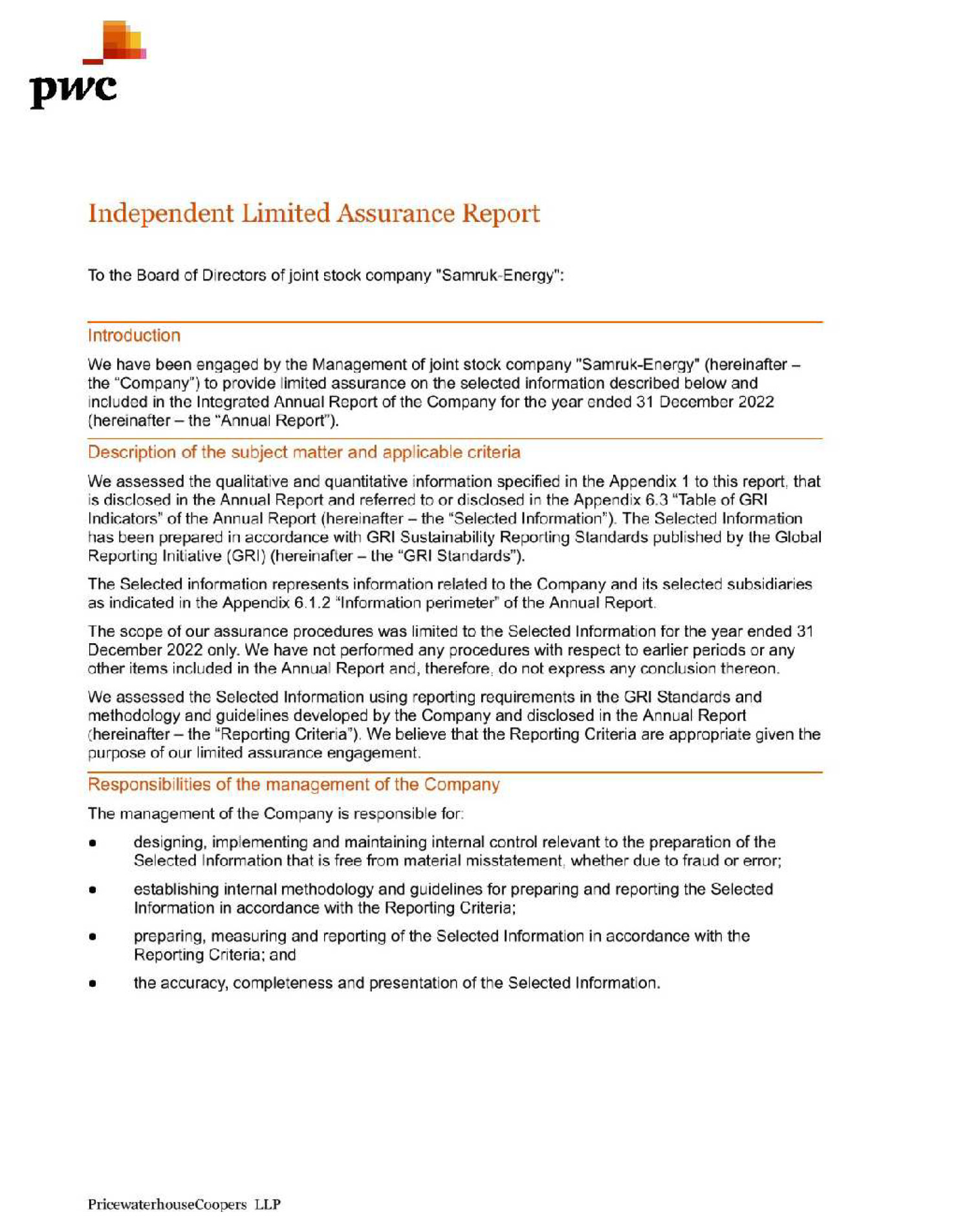
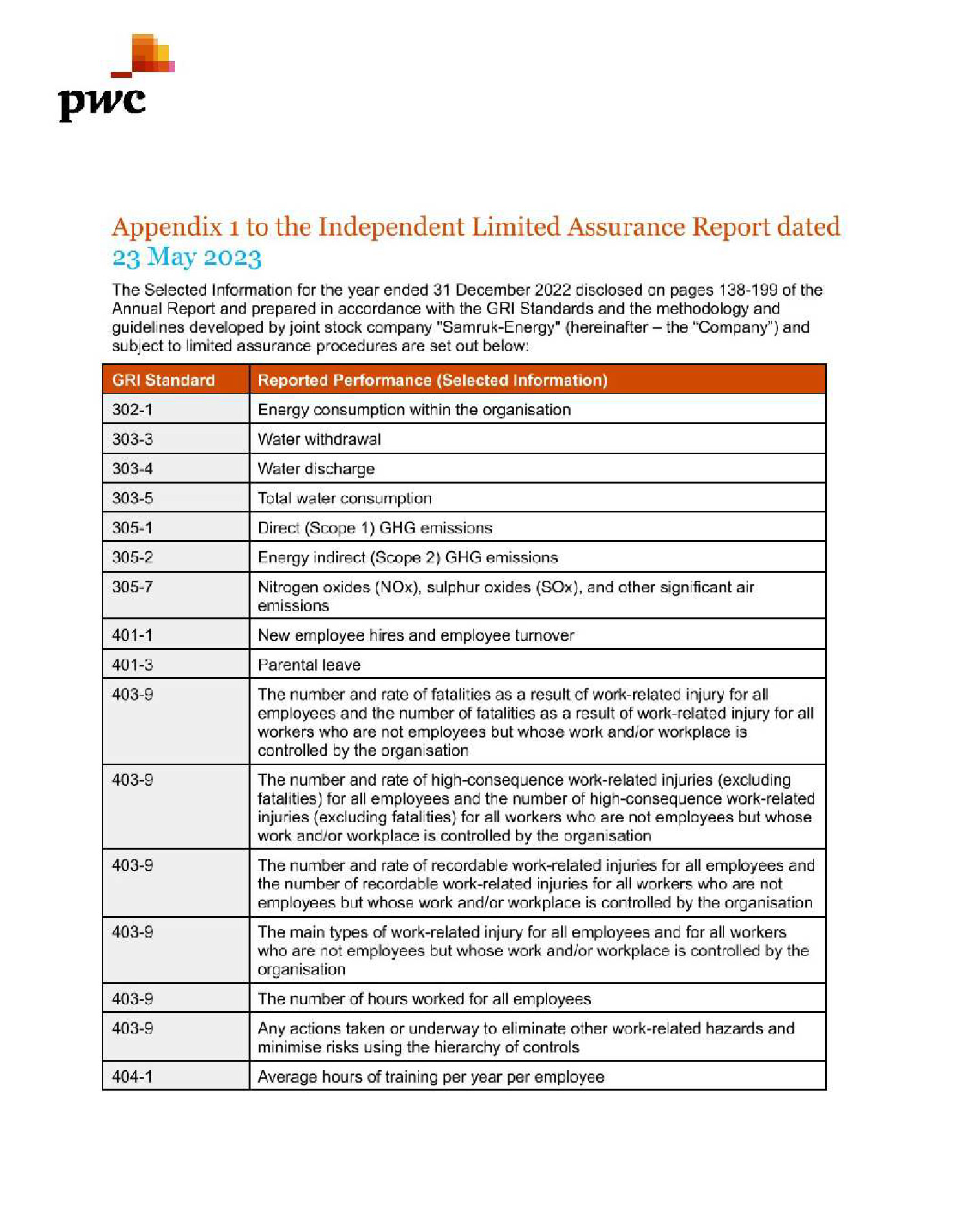
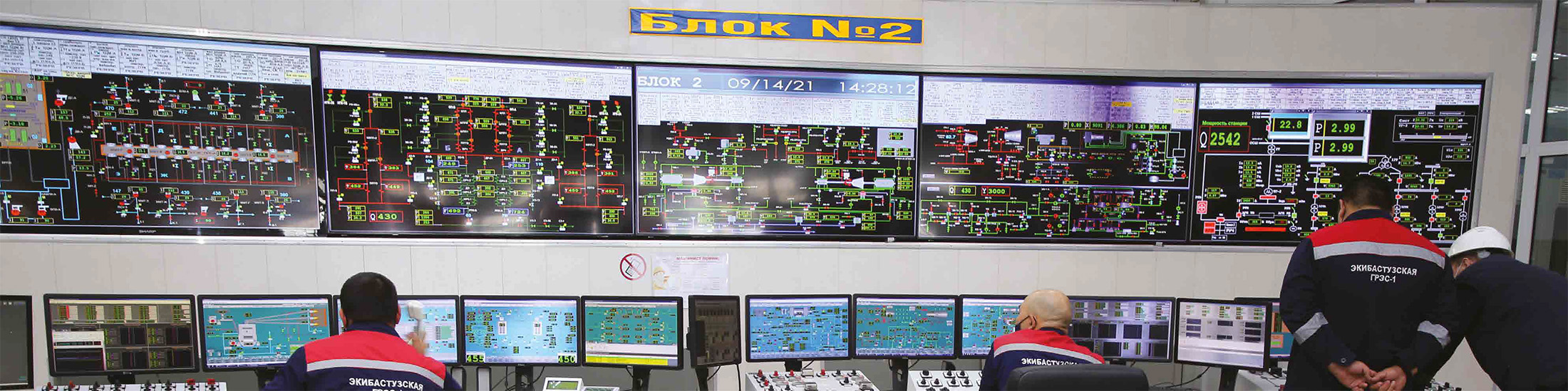
Index
| Area | Indicators | Performance indicators | |
|---|---|---|---|
| A | Economic area | ||
| А.1 | Revenue and/or (net) value added | A.1.1: revenues | KZT 381,465 million |
| A.1.2: Value added | KZT 112,656 million | ||
| A.1.3: Net value added | KZT 30,132 million | ||
| А.2 | Payments to the Government | А.2.1 Taxes and other payments to the Government | KZT 36,907 million |
| А.3 | New investment/ expenditures | A.3.1: Green investment | KZT 7.1 billion |
| A.3.2: Community investment | KZT 46 million | ||
| A.3.3: Total expenditures on research and development | - | ||
| А.4 | Total cost of local supplier/purchasing programmes | A.4.1: Percentage of local procurement | 98.17% |
| B | Environmental area | ||
| B.1 | Sustainable use of water resources | B.1.1: Water recycling and reuse | 3,534,516 megalitres |
| B.1.2: Water use efficiency | Total water withdrawal was 22,415,180 megalitres | ||
| B.1.3: Water stress | Water withdrawal 2022:
|
||
| B.2 | Waste management | B.2.1: Reduction of waste generation | In 2022, the Company generated 89,929,908.3 tonnes of waste |
| B.2.2: Waste reused, remanufactured and recycled | Total waste recovered In-house - 12,856.78 Outsourced - 22,951.87 |
||
| B.2.3: Hazardous waste | 646.9 tonnes | ||
| B.3 | Green house gas emissions | B.3.1: GHG emissions (Scope 1) | 32.99 million tonnes CO2-eq. |
| B.3.2: GHG emissions (Scope 2) | 13,333.6861 million tonnes CO2-eq. | ||
| B.4 | Chemicals, including pesticides and ozone-depleting substances | B.4.1: Chemicals, including pesticides and ozone-depleting substances | NOx – 80,147.348 tonnes SOx - 223,331.13 tonnes Solid substances - 48,063.653 CO - 6,217.23 tonnes Volatile organic compound emissions (VOCs) - 313.382 tonnes Hazardous air pollutants (HAPs) - 358,079.069 Persistent organic pollutants (POPs) - 0 |
| B.5 | Energy consumption | B.5.1: Renewable energy | In 2022, the installed capacity of renewable energy facilities operated nationwide exceeded 2,388 MW. Electricity production by Samruk-Energy's RES facilities rose by 28.3% in 2022 to reach 8.3% of the total green electricity generated in Kazakhstan. |
| B.5.2: Energy efficiency | Total resource consumption - 340,079,000 GJ | ||
| C | Social area | ||
| C.1 | Gender equality | C.1.1: Proportion of women in managerial positions | Number of female managers was 84 in 2022. Women accounted for 20% of Samruk-Energy's Management Board. |
| C.2 | Human capital | C.2.1: Average hours of training per year per employee | Average number of hours spent on training of one employee was 35 manhours. |
| C.2.2: Expenditure on employee training per year per employee | KZT 17,373,000 | ||
| C.2.3: Employee wages and benefits as a proportion of revenue, with breakdown by employment type and gender | Salary of entry-level employee across the
Group: Men - KZT 186,000 Women - 170,000 |
||
| C.3 | Employee health and safety | C.3.1: Expenditures on employee health and safety as a proportion of revenue | Money spent to ensure compliance with H&S standards made KZT 3.789 billion in 2022. |
| C.3.2: Frequency/incident rates of occupational injuries | Work-related accidents: 10. | ||
| C.4 | Coverage by collective agreements | C.4.1 Percentage of employees covered by collective agreements | The collective bargaining agreements cover 95% of employees of the Company |
| D | Institutional area | ||
| D.1 | Corporate governance disclosure | D.1.1 Number of board meetings and attendance rate | In 2022, the Board of Directors met 17 times (11 in-person meetings and 6 meet-ings in absentia. The attendance of meetings by Board members was 100%. |
| D.1.2 Number and percentage of women board members | 0% | ||
| D.1.3 Board members by age range | 30-50 – 57% 50+ - 43% |
||
| D.1.4 Number of meetings of audit committees and attendance rate | In 2022, the Committee met eight times in person to consider 55 matters. The key matters covered the work of Internal Audit, Compliance, and the Risk Management and Internal Control Department. The attendance rate of voting members was 100%. | ||
| D.1.5 Total compensation and compensation per member of the board of directors and management | Remuneration of Independent Directors amounted to KZT 48.737 million in 2022. Key management personnel remuneration amounted to KZT 295,528,000 in 2022. | ||
| D.2 | Anti-corruption practices | D.2.1 Amount of fines paid or payable in accordance with the convictions | The total number of acts of noncompliance with laws and regulations is 41. In all cases, fines totalling KZT 913.2 million were imposed. There were no cases in which non-monetary sanctions were imposed |
| D.2.2: Average hours of training on anticorruption issues per year per employee | In the reporting period, Samruk-Energy held 34 training events across the Group, with the average number of training hours per employee being 0.002 hours in 2022. | ||

Regulations
| Material topic | Key Regulations | Links |
|---|---|---|
| Climate change and the environment | ||
| Sustainability | Samruk-Energy JSC Sustainability Guidelines | https://www.samruk-energy.kz/images/board-of-directors/1.pdf |
| Energy transition to sustainable sources | Samruk-Energy Energy Transition Programme 2022- 2060 | https://www.samruk-energy.kz/ru/company/low-carbon-development |
| Water management | Corporate Management System of Samruk-Energy Group of Companies (covering good governance, health and safety, environmental protection, energy efficiency, information security, anti-corruption, and anti-fraud) | https://www.samruk-energy.kz/images/ Corporate_documents/Politika_KSM.pdf |
| Air quality | ||
| Sustainable waste management | ||
| Caring for people | ||
| HR management, development and motivation | Samruk-Energy HR Policy 2018-2028 | https://www.samruk-energy.kz/images/board-of-directors/kadr_pol.pdf |
| Health and safety at work |
1. SE-ST-02/01 company standard Motivating staff to behave safely 2. The Golden Rules of Safety company standard 3. SE-ST-04-02 Assessment of the HSE management system 4. Health and Safety Guidelines for Samruk-Energy JSC employees 5. HSE Risk Assessment company standard 6. SE-ST-06-02 Incident Reporting and Investigation 7. Guidelines for using the Safe Production Information System 8. Conducting a Behavioural Safety Leadership Audit company standard |
Available on the internal platforms |
| Diversity, equality and inclusion | Samruk-Energy JSC Communication on Progress 2022 | https://www.samruk-energy.kz/ru/navigation-and-support/sustainabledevelopment#tab13 |
| Good governance and integrity | ||
| Contribution to economic performance | Green finance policy | https://www.samruk-energy.kz/ru/corporate-governance/corporatedocuments#6 |
| Samruk-Energy Development Strategy 2022-2031 | https://www.samruk-energy.kz/ru/company/development-strategy | |
| Samruk-Energy JSC Management Report for 2022 (M&A Report) | https://www.samruk-energy.kz/ru/shareholders-and-investors/otherreporting | |
| Internal Control System Regulations | https://www.samruk-energy.kz/images/corp.documents/docs5/3.pdf | |
| Risk Identification and Assessment at Samruk-Energy JSC | https://www.samruk-energy.kz/images/corp.documents/docs5/2.pdf | |
| Samruk-Energy Risk Management Policy | https://www.samruk-energy.kz/images/corp.documents/docs5/1.pdf | |
| Sustainable supply chain | Procurement Procedures adopted by Sovereign Wealth Fund Samruk-Kazyna JSC and legal entities, which are 50+ percent directly or indirectly owned by Samruk-Kazyna JSC, either beneficially or upon trust | www.zakup.sk.kz |
| Compliance and anti-corruption practices | Samruk-Energy Anti-fraud and Anti-corruption Policy | https://www.samruk-energy.kz/ru/corporate-governance/corporatedocuments#6 |
| Samruk-Energy Compliance Risk Management Policy | Available on the internal platforms | |
| Samruk-Energy Policy on Corporate Conflicts and Conflicts of Interest | Available on the internal platforms | |
| Samruk-Energy Whistleblowing Policy | https://www.samruk-energy.kz/images/documents/politika_inform.pdf | |
| Samruk-Energy Code of Conduct | https://www.samruk-energy.kz/images/corp.documents/kodeks/2.pdf | |
| Corporate Governance Code | https://www.samruk-energy.kz/images/corp.documents/kodeks/1.pdf | |
| Corporate Management System of Samruk-Energy Group of Companies (covering good governance, health and safety, environmental protection, energy efficiency, information security, anti-corruption, and anti-fraud) | https://www.samruk-energy.kz/images/Corporate_documents/Politika_KSM.pdf | |

Highlights 2022
| Date | News |
|---|---|
| 27 January 2022 | Early repayment of KZT 15.2 billion in the principal to the Asian Development Bank |
| 1 February 2022 | MHPP JSC KZT 1 bn bonds are bought back on the AIX |
| 14 February 2022 | A Mandate Letter is signed by and between Samruk-Energy JSC, Almaty Power Plants JSC, and the European Bank for Reconstruction and Development as part of a project to upgrade Almaty CHPP-2 with low environmental impact |
| 26 April 2022 | Early repayment of KZT 8 billion in the principal to the Asian Development Bank |
| 16 May 2022 | Early repayment of the principal (KZT 2.6 billion) by Ekibastuz GRES-1 to Halyk Bank of Kazakhstan |
| 24 June 2022 | Changes are made to some auction bidding terms and conditions65 |
| 30 June 2022 | Return on investment in the Almaty CHPP-2 project66 |
| 30 June 2022 | Adjusted electricity ceiling tariffs are approved for Almaty Power Plants, Moynak HPP, and Shardarinskaya HPP with effect from 1 July 202267 |
| 21 July 2022 | The 60 MW Shelek Wind Farm is commissioned in Enbekshikazakh District, Almaty Province. Energia Semirechya LLP |
| 22 July 2022 | MHPP JSC KZT 5 bn bonds are bought back on the AIX |
| 26 July 2022 | Early repayment of KZT 15.4 billion in the principal to the Asian Development Bank |
| 18 August 2022 | Tariff ceilings and tariff estimates 2022-2026 are approved for Alatau Zharyk Company with effect from 1 September 202268 |
| 26 August 2022 | Price caps are approved for AlmatyEnergoSbyt with effect from 1 September 2022 |
| 27 August 2022 | New tariffs are set for regulated heat production services of Almaty Power Plants69 |
| 5 September 2022 | Samruk-Energy fully redeems SNRGb2 bonds for KZT3.1bn at KASE as scheduled |
| 7 September 2022 | The Company's second bond programme worth KZT 120bn is registered to finance Almaty Power Plants gasification projects. |
| 26 September 2022 | Samruk-Energy obtains an opinion from the Ministry of Energy of Kazakhstan and a written opinion from the Prime Minister that power generation facilities are considered to be equipment |
| 30 September 2022 | Early repayment of the principal of KZT 16.8 billion to Halyk Bank of Kazakhstan |
| 7 October 2022 | Samruk-Energy's second bond programme for KZT 120bn is registered |
| 27 October 2022 | Open two-stage international tender starts to select an EPC contractor for the implementation of the Almaty CHPP-2 gasification project under EBRD rules |
| 4 November 2022 | Qazaq Green Power PLC a subsidiary under the jurisdiction of the Astana International Financial Centre is established within the Company to con-solidate the Company's green assets under its umbrella70 |
| 9 November 2022 | Fitch Ratings upgrades Samruk-Energy JSC's long-term credit ratings by from "BB" to "BB+", outlook stable, the standalone credit profile from "b+" to "bb-", and its unsecured debt from "BB" to "BB+" |
| 25 November 2022 | KZT 130 bn loan agreement is made between Almaty Power Plants and EBRD as part of Almaty CHPP-2 gasification project |
| 25 November 2022 | A letter of intent to provide financing for the Almaty CHPP-2 gasification project is signed between the Development Bank of Kazakhstan and Almaty Power Plants |
| 28 November 2022 | QazaqGaz and Samruk-Energy sign a contract for the sale of Samruk-Energy's 100% stake in Tegis Munay LLP, which includes Mangyshlak Munay LLP |
| 30 November 2022 | Rules are approved for consideration of investment programmes of mod-ernisation, reconstruction and (or) expansion with construction of generating plants using gas as an alternative fuel, conclusion of investment agreements for modernisation, reconstruction and (or) expansion with construction of generating plants using gas as an alternative fuel, conclusion of contracts for purchasing capacity availability management services and setting individual tariffs under these contracts, the scope and timing of the purchase of capacity availability management services.71 |
| 20 December 2022 | The Fund contributed KZT 2.5 billion to the statutory capital of Samruk- Energy. The contribution would be transferred to the statutory capital of Alatau Zharyk Company under the project for reconstruction of cable networks in Almaty. |
| 20 December 2022 | MHPP JSC KZT 2 bn bonds are bought back on the AIX |
| 29 December 2022 | Kazakhstan amends the Tax Code, including the exemption of power transmission entities from CIT charged when taking over power grids from owners not engaged in power transmission |
| 30 December 2022 | Kazakhstan amends the Law On Natural Monopolies to introduce additional conditions for the adjustment of electricity transmission tariffs approved for five years before expiry (change in the approved investment programme due to the implementation of national projects, putting the networks on the books and/or under trust management, change in the average monthly nominal wage), with amendments coming in effect on 12 January 2023 |

AIX – Astana International Exchange, a stock exchange for investment in Kazakhstan and Central Asia, established under Astana International Financial Centre. AIX's mission is to develop sound and liquid capital markets in Central Asia and beyond by offering innovative products and services to businesses and investors.
CAPEX – Capital expenditure.
Samruk-Kazyna Sovereign Wealth Fund – a Kazakh investment holding company founded in 2008 to promote Kazakhstan's national welfare and modernise the national economy. The Government of Kazakhstan is the sole shareholder of the company.
ADCS – automated dispatch control system designed to monitor and control the operation of the equipment.
Electricity balance of a grid – a system of indicators to show the match between electricity consumption in the grid, auxiliary consumption, and losses in networks against electricity supply, taking into account power flows.
Benchmarking – a process to identify, understand, and adapt current good practices to improve organisation's performance. Analysis involves two processes: evaluation and comparison. Usually the best products and marketing process used by direct competitors and firms in other similar fields are taken as a baseline to see how the organisation can improve its products and practices.
RES – renewable energy sources where relatively constant or cyclical energy flows derived from natural sources are replenished at a rate that exceeds the rate of consumption. RES include solar (SES), wind power plants (WPP), small hydropower plants, and biogas plants.
The World Bank – an international financial institution established to provide financial and technical assistance to developing countries.
WPP – a wind farm with one or more wind turbines assembled in one or more locations and interconnected into a grid. Large wind farms can have 100+ wind turbines. WPPs are sometimes called wind parks.
GRES – a state district power plant/condensing power plant, a thermal power plant producing mainly electricity using local energy resources (peat, lignite, etc.) and supplying power primarily to a specific district.
HPP – a hydroelectric power plant that uses the movement of water in watercourses and tidal movements as a source of energy.
Monetary environment/monetary policy (MP) – a public policy, a set of measures aimed at managing aggregate demand through money market (short-term interest rate, nominal exchange rate or current liquidity level of the banking sector) to achieve a combination of ultimate objectives, which may include price stability, stable exchange rate, financial stability, and boosting balanced economic growth.
Subsidiaries and affiliates – subsidiaries and affiliates of Samruk-Energy Group of Companies.
EDB – the Eurasian Development Bank, an international financial institution which invests in the Eurasian region and promotes the strengthening and expansion of economic ties, as well as the comprehensive development of its member states: Armenia, Belarus, Kazakhstan, Kyrgyzstan, Russia, and Tajikistan. The authorised capital of the EDB is $7 billion. Projects with integration effects in transport infrastructure, digital systems, green energy, agriculture, industry and mechanical engineering account for the biggest share of the EDB's portfolio. The Bank operates in line with the UN Sustainable Development Goals and ESG principles.
EBRD – the European Bank for Reconstruction and Development, an investment vehicle set up to support market economies, private and entrepreneurial sector and democracy in 34 countries, from Central Europe to Central Asia.
UEPS of Kazakhstan – the Unified Electric Power System of Kazakhstan with power plants, transmission lines, and substations that provide reliable and quality power supply to consumers in Kazakhstan.
KASE – Kazakhstan Stock Exchange, a stock exchange headquartered in Almaty, which ranks second among CIS exchanges in terms of equity market capitalisation.
Quota-based installation – an installation with a greenhouse gas emission allowance exceeding 20,000 tonnes of carbon dioxide per year in regulated sectors of the economy.
AIFC – Astana International Financial Centre established on the initiative of the First President of the Republic of Kazakhstan, Yelbas Nursultan Nazarbayev. AIFC's mission is build a leading international financial services centre to promote and attract investment in the national economy, create an enabling environment for investment in financial services, develop the securities market in Kazakhstan and ensure its integration with international capital markets.
Heating period – autumn and winter heating season. The start and end dates of the heating period are set by the relevant regulations of the local governments.
Busbar output – a technical term describing the technological process of transmitting energy in series: from the energy generating (load serving) entity to the energy distributor and then to the end consumer.
Available capacity – the installed capacity of a generating unit (power plant) minus its capacity constraints.
ROI (return on investment) – a strategic efficiency/return on investment/performance indicator that demonstrates the effectiveness of an investment both when the budget is large and when the expenditure is small, meant to cover current needs.
Capacity market – a market where capacity is a special commodity. When purchasing it, a wholesale market player is entitled to demand from capacity sellers to keep generating equipment ready to generate electricity.
Net power flow – the algebraic sum of the flows over all interconnections of a given grid with other power systems.
Synchronous zone – a combination of all power systems operating in parallel that share a common frequency of electric current.
OHSMS – the occupational health and safety management system of the organisation, which ensures the safety and health of all employees and prevents occupational accidents and diseases at work.
SPP – a solar power plant that converts solar radiation into electrical energy. The ways in which solar energy is converted vary and depend on the design of the power plant.
Feasibility study – a paper that provides information on the feasibility/non-feasibility of a product or service, as well as a cost-benefit analysis of the project.
Installed capacity – the total nominal electrical power of the electric machines of the same type. The term is used to estimate the generated or consumed capacity of electricity systems, both of individual organisations and enterprises, and of industries and geographical regions as a whole. The nominal capacity can be either the rated active power expressed in watts, or the rated apparent power expressed in volt-amperes. In the energy sector, the installed capacity of an electrical installation is also referred to as the highest active electrical power at which the installation can operate continuously without overload, as specified in the technical specifications of the equipment.
IPCC – in-pit coal crushing and conveying where production is a single process flow in a mining company, with some processes carried out in cycles and others, in continuous modes.
The Shelek Corridor – a geographical area in the Enbekshikazakh District of Almaty Province near the border with China, considered to be an ideal place to install wind turbines as the wind always blows there. Experts call the area unique as the average annual wind speed at an altitude of 50 m is 7.8 metres per second and the flux density is 310 W/m2.
Information
Tasbulatov Rinat Yermekovich
Press Secretary
Phone: +7 (7172) 55-30-62
email: r.tasbulatov@samruk-energy.kz
Aisarieva Madina Bekaidarovna
Director of the Corporate Governance and Sustainable Development Department
Phone: +7 (7172) 55-30-20
email: m.aisarieva@samruk-energy.kz
Samruk-Energy Group of Companies Headquarters
010000, Astana
15A Kabanbay Batyr Avenue, “Q” Business Center, Block B
Phone: + 7 (7172) 55-30-00, + 7 (7172) 55-30-21
Fax: +7 (7172) 55-30-30
email: info@samruk-energy.kz
Auditor of Samruk-Energy JSC
PriceWaterhouseCoopers LLP
Almaty city, Republic of Kazakhstan, A25D5F6
34 Al-Farabi Avenue, Building «A,» 4th floor
Phone: +7 727 330 32 00
Registrar of Samruk-Energy JSC
Central Securities Depository Joint Stock Company
050040/A15P5B5, Almaty city, Republic of Kazakhstan
+7 (727) 262 08 46, 355 47 60
email: csd@kacd.kz, web@kacd.kz